
10 min read
AI Agents for Ecommerce: What They Are and How They Work
By ExactFlow Team
June 17, 2026
E-commerce is going beyond automation. Stores no longer need just tools to repeat tasks, but they need systems that can think, make decisions and act in context. This is where the AI agents for e-commerce step in.
These agents will no longer just be used for commands: they will start helping online stores to sell better, support customers more quickly, manage businesses more effectively, and ease the manual workload.
What Is an AI Agent in Ecommerce?
It's essentially a software system that is able to observe data and make decisions depending on goals, and take steps without having to wait for somebody to approve each step. In contrast to a simple chatbot or rule-based workflow, it can tailor to situations and execute multiple steps at once.
This is the essence of agentic commerce, where AI will not only help a store but actively run parts of it. In a model like that, the business grows to be more receptive, more efficient and more scalable without requiring the same additional amount of human work. DigitalOcean gives a simple breakdown of how AI agents differ from basic chatbots.
Why this matters
- It allows to minimize repetitive work.
- It enhances the response time.
- It brings a team to think more about strategy than routine activities.
- It makes the customer and employee experience more enjoyable.
What Is Agentic Commerce?
It's the concept of AI agents acting independently on e-commerce processes, making valuable decisions and taking action. The next best step can be set by the system without needing to wait for a human to decide for each task.
Agentic commerce, in reality, is the ability for an agent to see and notice the abandoned cart, offer a follow-up, confirm stock and trigger action to recover sales. This is more effective than simple automation, which operates according to preordained rules, as it reacts to context.
As more e-commerce businesses transition to autonomous AI agents, these stores are getting smarter at the steps where manual intervention typically hinders business progress.
How Do AI Agents Work in Online Stores?
The process typically includes the following four steps:
1. Observe
The agent monitors sales, support, inventory, finance, and HR data from a system.
2. Reason
It reads data and uses it to compare with metrics like churn reduction, conversion lift and delays cut.
3. Act
It executes the next task (e.g., sends a message, updates a system, routes a task, or creates a recommendation).
4. Learn
It is more useful over time because it makes use of outcomes to enhance future actions.
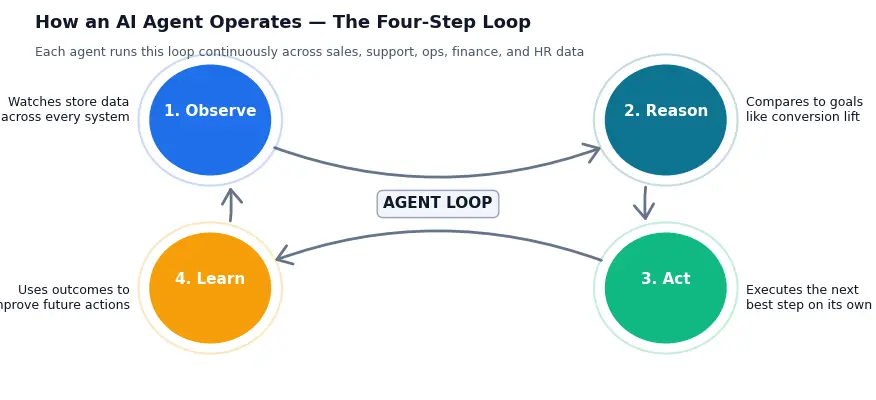
This is the reason why AI agents for e-commerce are unique from common automations. They don't only pass information on from one step to another. They assist the business in determining what to do with that information. Microsoft Copilot explains the difference between conversational tools and agents that take action.
Types of AI Agents in Ecommerce
Different agents are needed to address different issues. The best purpose-built AI agents for online sellers are created for a specific function in the business and not just general chats with humans.
Sales agents
The sales agents track conversion rate, refine offers and suggest product packages. A robust AI sales agent for e-commerce can assist in boosting average order value, re-engaging hesitant customers, and advising customers to make purchases at the right time and with the right products.
For instance, if a customer puts one product in their cart, then the agent could offer a bundle or a product they relate to, increasing the value of their order.
Support agents
Support agents are available 24/7 to deal with FAQs, refunds and shipping updates. By providing instant answers, even outside of business hours, a well-designed AI support agent e-commerce automation system can help lower ticket volume and boost satisfaction levels.
This is particularly significant if the store has many overseas customers or has a high order volume.
Operational agents
Operational agents organise logistics and distribution of resources. An AI operational agent e-commerce solution can assist you in redirecting orders, monitoring exceptions, spotting bottlenecks, and maintaining smooth e-commerce fulfilment.
With more predictable operations, the overall store has more reliability.
HR agents
HR agents automate payroll or the hiring of e-commerce staff. An AI HR agent for e-commerce teams can speed up the hiring process, provide onboarding guidance, and manage back-office tasks to let HR work on more value-added tasks.
Purchase agent
An AI purchase agent for online retail can assist in handling purchasing decision-making, supplier demands, replenishment logic, and procurement processes. If a store has lots of SKUs, it can help reduce shortages and over-ordering.
Financial agent
An AI financial agent for e-commerce businesses can help with reconciliation and expense categorisation, margin checks and financial reporting. It saves leadership from having to do the manual spreadsheet work, allowing them to make decisions more quickly.
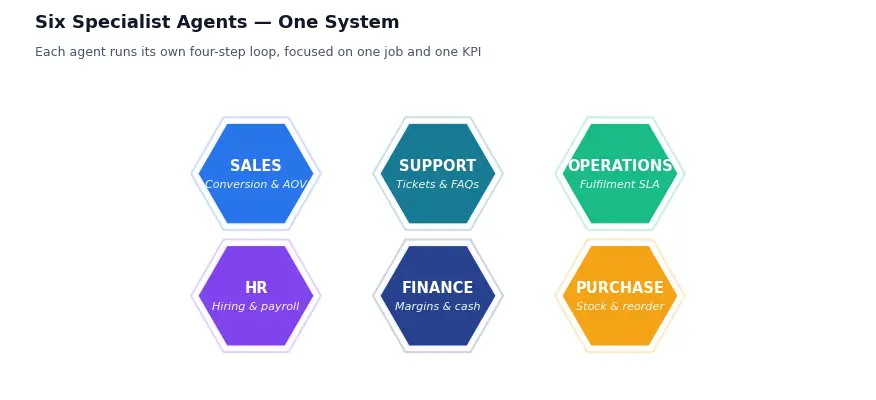
Table 1 · Agent specialization map — each agent through its four-step loop
| Agent | Observes | Reasons for | Acts on | First use case |
|---|---|---|---|---|
| SALES | Cart events, browse paths, repeat-visit signals | Buying intent, hesitation, bundle fit | Trigger an offer or a bundle or even a follow-up at the moment. | Cart recovery |
| SUPPORT | Tickets, chat sessions, sentiment in messages | Intent of the question, urgency, complexity | Answers questions directly. Also routes the really complex cases with full context so that someone can look at them and understand what is going on. | FAQ deflection |
| OPS | Orders, fulfilment status, and carrier delays | SLA risk, routing efficiency, exceptions | Re-routes things that are not going well, flags things that are holding everything up, and fixes the order before it slips. | Exception triage |
| FINANCE | Transactions, payouts, expense lines | Margin pressure, miscategorized lines, anomalies | Reconciles things, categorises them and even drafts the management report. | Monthly close |
| PURCHASE | Sell-through rate, lead times, supplier reliability | When to reorder, how much, from whom | Drafts a purchase order. Then it queues it for a human to approve it if it is over a certain threshold. | Replenishment |
| HR | Applications, payroll cycles, and onboarding tasks | Candidate fit, payroll exceptions, missing steps | Screens resumes and automates the onboarding process for people. It surfaces any issues that come up during this process so that someone can look at them and fix them. | CV screening |
How Autonomous AI Agents Help Ecommerce Teams
Every day, the rise of autonomous AI agents used by e-commerce teams is changing the game of e-commerce stores. Rather than simply being a tool for answering questions, brands are now implementing AI as a digital worker for a business activity.
Real benefits
- Faster execution.
- Lower operational cost.
- Better consistency.
- Improved customer and staff experience.
It is important for stores that desire growth, as the problem doesn't always lie in the traffic or the product; it lies in how fast the business can respond.
AI Agent Software for Ecommerce Sellers
To make these capabilities useful, stores need the right AI agent software for e-commerce sellers. A good software should do more than just link apps. This should know the business's desired goals, take intelligent actions, and help various teams in the company.
What to look for
- Multi-step task handling.
- Seamless sales, support, finance and operations integration.
- Clear dashboards and reporting.
- Human override if required.
- Flexibility for business expansion.
An agentic e-commerce platform integrates all of this into a single solution. Teams can coordinate sales, support, finance and operations through a single unified system instead of separate tools.
To help visualize how these functions can be combined effectively in a practical configuration, it's better to think in terms of specialized agents vs. one single ‘all-purpose’ tool.
Why Ecommerce Brands Need Purpose-Built Agents
One of the biggest mistakes businesses make is expecting one AI tool to do everything. In reality, the best results come from purpose-built AI agents for online sellers that are designed for one job and do it well.
Why does this work better?
- A sales agent knows how to improve conversion.
- A support agent knows how to reduce ticket friction.
- An operations agent knows how to keep fulfillment organised.
- A financial agent knows how to protect margins.
- An HR agent knows how to reduce admin in hiring and payroll.
That focus makes each agent more reliable and more valuable. It also makes it easier for teams to trust the system, because the goal is clear and measurable.
How E-commerce Teams Should Start
You do not need to automate everything at once. The best way to begin with AI agents for e-commerce is to find the most repetitive, high-friction work and start there.
Good first use cases
- Answering common support questions.
- Recovering abandoned carts.
- Updating stock and fulfilment tasks.
- Screening finance or HR admin.
- Triggering replenishment requests.
Start small, measure results, and expand from there. That makes it easier to see what works and where the biggest gains are.
Conclusion
AI is revolutionizing e-commerce from automation to intelligence. As stores leverage AI agents for e-commerce efficiently, they develop systems that can enable them to sell, support, organise, and scale with less manual effort. Agentic commerce is not all about smarter tools but also smarter business operations.
The successful brands will be those that believe in using AI as an actual operational tool and not as a chatbot or novelty. When e-commerce teams have the right combination of sales, support, operations, finance and human resources agents, they can go faster, cut down errors, and provide better experiences at every stage.
ExactFlow helps e-commerce businesses use AI agents to streamline sales, support, operations, finance, and hiring so they can scale with less manual work.
With AI-powered tools getting better by the day, the opportunity to save time is nothing compared to creating an online store that thinks and acts faster, and more consistently, than a human team ever could.
Frequently Asked Questions
What is an AI agent in e-commerce?
What is an AI agent in e-commerce?
An AI agent in e-commerce is a system that can observe data, make decisions, and take actions to help run parts of an online store.
What is agentic commerce?
What is agentic commerce?
Agentic commerce is a model where AI agents operate across e-commerce workflows with enough autonomy to complete tasks and support business goals.
How do AI agents work in online stores?
How do AI agents work in online stores?
They observe store data, reason about what it means, take an action, and improve based on results over time.
What is the difference between AI agents and chatbots?
What is the difference between AI agents and chatbots?
Chatbots mostly answer questions. AI agents can also complete tasks, trigger actions, and support business processes.
Which ecommerce teams benefit most from AI agents?
Which ecommerce teams benefit most from AI agents?
Sales, support, operations, finance, and HR teams often benefit the most because they handle repetitive work and need fast, consistent responses.
Do e-commerce businesses need different agents for different tasks?
Do e-commerce businesses need different agents for different tasks?
Yes. Purpose-built agents usually work better than one generic system because each agent can focus on a specific function like sales, support, or finance.