

10 min read
How to Manage eBay, Amazon, and Shopify from One Dashboard
By ExactFlow Team
June 15, 2026
If you sell on eBay, Amazon, and Shopify, this blog explains how a single dashboard can simplify inventory, orders, reporting, and customer support so your team can manage every channel with less manual work and more control.
One Dashboard for Multiple Marketplaces
Selling on eBay, Amazon, and Shopify is extremely quick in bringing revenue into the company, but they also have the potential to create an unholy mess behind the scenes. Orders are received in various locations, inventory records are dynamic, and inquiries by customers will never cease. This is why brands that want to manage e-commerce marketplaces require a more connected, simpler way to operate.
You can view all data in a single dashboard, eliminate manual tasks, and make quicker decisions. Your team will be able to work on selling, fulfilment, and customer service as opposed to spending all day jumping around the tabs.
Why Multi-Channel Selling Gets Complicated
There are separate rules, dashboards, and paces to every marketplace. Amazon is rather fast, eBay may be more listing and pricing intensive, and Shopify offers more direct control over your brand but requires an ongoing tune-up. updates.
If you manage multiple marketplaces, small errors can quickly add up. If a stock is sold out in one channel, it can be oversold in another channel. If a price update is not applied to one platform, it can affect the margin ratios. If an order is not updated on time, it leads to customer dissatisfaction.
Common pain points
- No real-time inventory sync.
- Orders are distributed throughout the various systems.
- Multiple customer messages are received in several inboxes.
- Reports are spread across different dashboards.
- Too much time spent on manual updates.
This is why you should consider hiring the best online platform for e-commerce marketplaces over spreadsheets and multiple logins.
What One Dashboard Actually Solves
Having a central dashboard isn't merely about convenience. It establishes a much more efficient organizational process for business.
Inventory visibility
Amazon, eBay, and Shopify stocks can be tracked together. This ensures that the inventory is not oversold and prevents customer dissatisfaction.
Order management
Your team can process all channels from one view instead of having to check them one by one. This makes the fulfilment more efficient and consistent.
Customer support
Combining order history, shipment status, and platform information streamlines the way the support team can handle inquiries.
Reporting
With just one dashboard, you'll be able to compare performance across channels and know where growth is coming from.
Centralizing is the true unlock if your team wants to manage multiple marketplaces without all the daily hassle.
How eBay, Amazon, and Shopify Fit Together
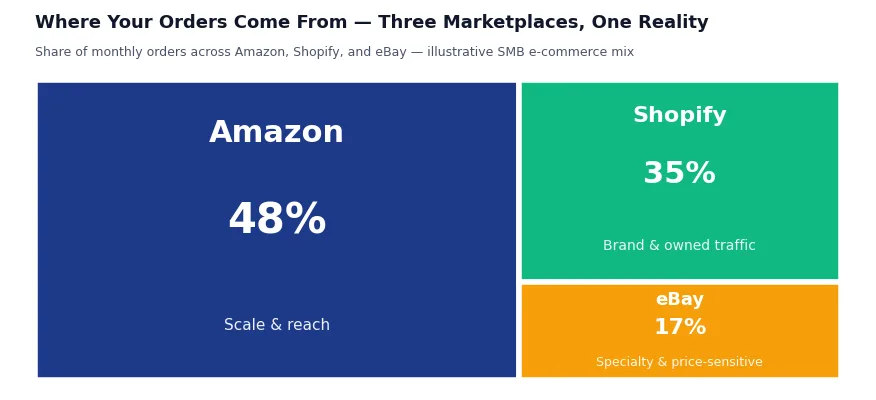
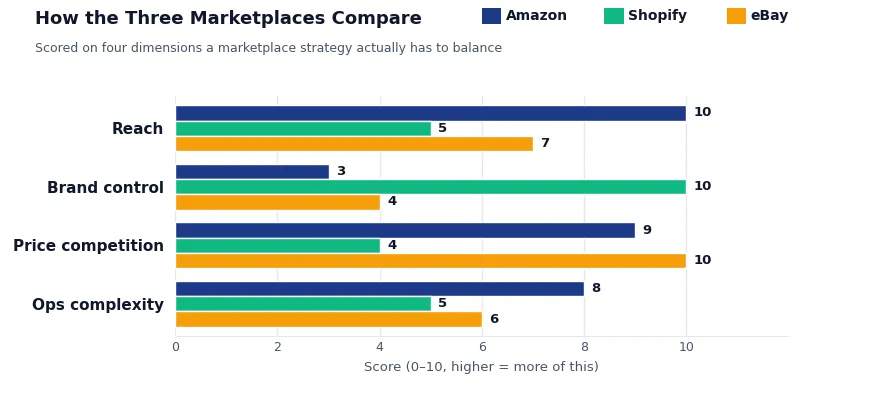
Every platform has a unique purpose in your e-store business.
eBay
eBay tends to be a good choice for competitive pricing, specialty items, and those who enjoy shopping from a wide variety. It is a good medium to test the demand.
Amazon
A significant contributor to scale is typically Amazon. It can be used to boost reach, but it also requires speed, comprehensive fulfilment, and careful monitoring of performance metrics.
Shopify
Shopify provides the most control for experience, customer data, and owned traffic. It is often the foundation of the brand itself.
A good system is useful for managing e-commerce marketplaces and recognizing the strengths of each marketplace rather than expecting them to function in the same manner.
Table 1 · How the three marketplaces differ operationally — and what centralization unlocks
| Operation | Amazon | Shopify | eBay | UNLOCK With the central dashboard |
|---|---|---|---|---|
| Inventory | Strict, near-real-time; mistakes are penalized | Real-time via the platform you control directly | Listing-level, often manual edits | One source of truth; oversells across channels stop |
| Orders | High volume, fast SLAs, strict carrier rules | Owned flow; you control fulfilment choices | Lower volume; varied buyer expectations | All orders in one queue; auto-routed by region & cost |
| Customer messages | In-platform messaging, strict response SLAs | Direct + branded comms (email, on-site chat) | In-platform messaging, slower expectations | Single inbox; full order context attached to every ticket |
| Returns | A-to-Z guarantee; complex rules per category | Full policy control; you set the workflow | Buyer protection rules; case-by-case judgment | Unified returns flow; reasons categorised across channels |
| Pricing changes | Algorithmic Buy-Box dynamics; competitor-driven | Branded campaigns; promo control is yours | Manual edits per listing; competitive pressure | Price sync across channels; no surprise undercuts |
It's helpful to understand how Shopify refers to multichannel commerce.
What to Look For in a Unified Dashboard
Not every tool is built for true marketplace control. The right setup should convey more information than just numbers.
Core features to look for
- Real-time inventory sync.
- Centralised order processing.
- Unified customer communication.
- Channel-level reporting.
- Automation rules for routing and updates.
- Easy integration with fulfilment and finance tools.
The best systems do not just collect data. They help you act on it.
If you are interested in exploring a platform around connected operations, look at ExactFlow.
How AI Helps You Scale
AI is automating and making the marketplace management smarter, not only quicker. Can detect patterns, warn of risks, and minimize repetitive work.
Smarter forecasting
With AI, you can identify items that are selling more quickly on Amazon than in a Shopify store or eBay listings that should be optimized more to generate sales before they expire.
Better support routing
Any question from a customer is prioritized by urgency or by channel, ensuring the appropriate team sees the right issue first.
Faster decisions
AI can enable teams to respond to stock changes, order delays, and demand fluctuations in real-time, rather than relying on manual reporting.
That is one of the reasons why many businesses nowadays are seeing a central dashboard as the leading e-commerce solution for a marketplace approach.
Use the ExactFlow pricing as a starting point for pricing and rollout planning.
Building a Better Marketplace Workflow
To really get value from a dashboard, you need more than visibility. You need workflows.
1. Connect your channels
Integrate Amazon, eBay, and Shopify into one system to ensure that your data is in a single source.
2. Set automation rules
Set rules on stock levels, order routing, and alerts to avoid manual work for your team.
3. Review exceptions only
Use automation for the routine orders, but keep human intervention for margin calls, customer queries, and other unusual orders.
4. Keep improving
Optimize listings, pricing, and fulfilment over time by leveraging your dashboard data.
This is how user-friendly teams of today deal with their eCommerce marketplaces with less hassle and more control.
To learn more about the company behind these workflows, check out About Us.
Where the Real Efficiency Comes From
The biggest win is not just saving clicks. It is reducing the amount of mental effort needed to keep operations running.
When data is scattered, teams waste time reconciling numbers, chasing updates, and fixing preventable errors. When everything lives in one place, your people can work faster and make better decisions.
That is especially important as you manage multiple marketplaces and want to keep fulfilment, customer service, and reporting aligned.
A connected system also helps leadership get a clearer picture of performance across the business. You are not just looking at sales; you are seeing the full operation.
Conclusion
Selling on eBay, Amazon, and Shopify does not have to mean managing three separate businesses. With the right dashboard, you can bring everything together, reduce manual work, and create a smoother operating system for your team. If you want to manage e-commerce marketplaces effectively, the key is centralisation, automation, and visibility.
A strong dashboard helps you manage e-commerce marketplaces by syncing inventory, streamlining orders, and giving each team member the information they need in one place. It also makes it easier to spot problems early and scale with confidence.
ExactFlow helps e-commerce teams connect channels, automate workflows, and simplify marketplace operations from a single view. Contact us today.
When your tools work together, your team can spend less time switching tabs and more time growing the business. That is what makes the best online platform for e-commerce marketplaces feel less like software and more like an operating system for growth.
For deeper guidance on marketplace strategies, Amazon offers a strong reference point for channel expectations and shopper behaviour.
Frequently Asked Questions
What is the best way to manage eBay, Amazon, and Shopify together?
What is the best way to manage eBay, Amazon, and Shopify together?
The best way is to use one centralized dashboard that syncs inventory, orders, and customer data across all three channels.
Why is it important to manage multiple marketplaces from one system?
Why is it important to manage multiple marketplaces from one system?
It reduces errors, saves time, and helps teams keep pricing, stock, and fulfilment aligned across every channel.
What should I look for in the best online platform for e-commerce marketplaces?
What should I look for in the best online platform for e-commerce marketplaces?
Look for real-time sync, automation, centralised reporting, and easy integrations with fulfilment and support tools.
How do leading e-commerce solutions for marketplaces help scale faster?
How do leading e-commerce solutions for marketplaces help scale faster?
They remove manual work, improve visibility, and allow teams to respond to changes quickly while keeping operations organized.