
10 min read
What Is an Ecommerce CRM and Why Does Your Store Need One?
By ExactFlow Team
July 3, 2026
As your store expands, your customer information begins to grow quickly. All orders are received through different avenues, every customer has the same questions, and reordering relies on the memorability of each customer. It's here that a good CRM shifts from a great add-on to something that becomes a standard part of the business day.
Why Every Growing Store Needs an Ecommerce CRM
Store owners have the misleading idea that growth happens only through traffic or more creative advertising. But in fact, improved customer management is frequently the source of long-term growth. Having a solid CRM tool in your toolbox helps you to track buyers, follow up on time, and ensure trust is established after the initial sale. This is why e-commerce CRM is essential for a growing online business that cannot afford to separate itself from its customers.
A CRM works to understand the complete connection with customers, rather than consider each a single purchase. It streamlines your team, your follow-up, and your service. HubSpot shares resources on how effective customer relationship solutions drive business growth.
What Is an Ecommerce CRM?
An e-commerce CRM is a solution that allows online retailers to handle customer data, monitor customer habits, and communicate better throughout the entire customer journey. Gives you all the information related to orders, contacts, support activities, and buyers (purchasing behaviour) in a single view.
Your team can view what your customer has purchased, when they last ordered, what support issue they experienced, and what they might need in the future. For a simple explanation, it helps remind your business of the customer, and your customer feels remembered.
Why this is useful
- It securely maintains customer information in a single location.
- It enables sales and support teams to effectively work from the same data source.
- It facilitates follow-up more easily and more relevantly.
- It facilitates retention and repeat purchases.
A good CRM is more than a database! It is a working system that assists you to respond smarter, which in turn helps you sell better with your store.
Why Your Store Needs One
Ecommerce stores tend to expand quicker than their systems. Initially, customers can be easily traced manually. When sales start to grow, however, things get complicated. Messages are lost, they forget to look for repeat customers, and the support staff does not always have the history of their customers.
This is where CRM for e-commerce is helpful. It assists you in streamlining and transitioning from information clutter to structured customer management. With the correct data in hand at the right moment, everything becomes easier with your team.
Common problems a CRM solves
- Lost follow-ups.
- Repeated customer questions.
- Poor visibility into buying behaviour.
- Weak retention after the first purchase.
- Slow response to high-value customers.
A well-implemented store with CRM is typically more consistent. Customers notice that. They receive better answers, more targeted and better offers, and smoother support.
How CRM Helps Ecommerce Teams
A CRM is helpful because it helps many areas of the business. The sales team is able to follow up more effectively. Support teams can respond with context. Marketing teams can send out more effective, relevant messages. Management will have a clear view of what is effective.
Sales
A CRM will enable the sales team to track leads, follow-up calls on interest, and determine future customer repeat sales. This means it will lead to fewer missed opportunities and more conversions.
Support
Support teams have access to order history and previous problems, making it quite easy to resolve problems quickly. That helps to make services better.
Marketing
Marketing teams are able to cluster customers by their behavior, purchase history, or engagement. That enables them to effectively convey a more useful, less random message.
Operations
The CRM data can provide insights for operations teams about customer trends, delays, or recurring problems that could impact the overall purchase journey.
That is why e-commerce CRM is becoming a very real component of how contemporary online stores can be used on a day-to-day basis. The ExactFlow pricing helps with planning for businesses who want to know pricing and rollout options.
What Makes a Good CRM in Ecommerce?
Not all CRMs are made for online retail! The ideal system should be flexible enough to meet the needs of real e-commerce businesses.
Look for these features
- Easy customer tracking.
- Order and purchase history.
- Support integration.
- Segmentation tools.
- Automation for follow-ups.
- Simple reporting.
The ideal systems are user-friendly and scalable to grow with the business. Too-complex CRMs are rarely used effectively by teams. This is a demonstration of how Salesforce enables retailers to access customer information and automate their operations.
A simple comparison
| Feature | Manual Tracking | CRM in Ecommerce |
|---|---|---|
| Customer history | Scattered | Centralised |
| Follow-up | Inconsistent | Automated |
| Segmentation | Limited | Strong |
| Support context | Hard to find | Easy to access |
| Retention tracking | Weak | Clear |
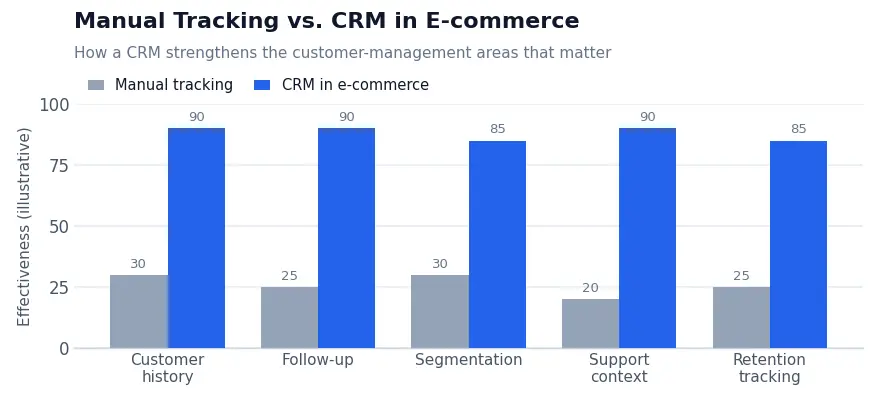
The table above explains why CRM in e-commerce can be advantageous over spreadsheet or inbox-oriented approaches.
Why Customer Relationships Matter More Than Ever
Many store owners pay a lot of attention to attracting new customers. That's important, but retaining current customers can be more rewarding. A CRM is a tool to enable you to do both in a better way. It helps you to streamline the initial sale and sustain the second sale more easily.
What good relationships bring
- More repeat purchases.
- Better customer loyalty.
- Higher lifetime value.
- Stronger brand trust.
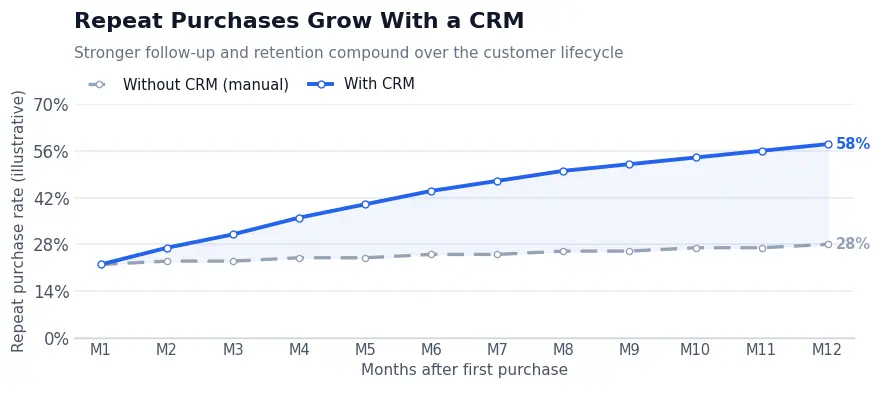
That's why the eCommerce CRM isn't just a sales instrument. It's a customer relationship tool that can be used by the whole business.
Why ExactFlow Fits This Conversation
ExactFlow is built for e-commerce teams that want more structure without making customer management harder. Instead of forcing teams to work from disconnected systems, it supports a more connected workflow across sales, support, operations, finance, and HR.
That matters because customer data should not sit in one place while teams work somewhere else. A better system helps the whole business act faster and stay aligned. ExactFlow CRM, Snoopy Doopy, helps e-commerce businesses create connected customer workflows that support sales, support, and retention in one system.
You can also explore Axel AI Support Agent if you want to see how customer support can become more intelligent and connected.
How to Use a CRM Well
A CRM only helps if the team actually uses it. That means clean data, simple habits, and clear ownership.
Best practices
- Keep customer records updated.
- Use tags and segments consistently.
- Set follow-up rules.
- Connect support and sales data.
- Review customer behaviour regularly.
The goal is not to collect more information for the sake of it. The goal is to use the information to make better business decisions.
If you want to understand how connected business workflows can support customer operations, the Kai AI Operational Agent is another useful example.
Conclusion
An online store can grow without a CRM for a while, but that growth usually gets harder to manage. Customers expect faster responses, more personal service, and better follow-up than manual systems can deliver. That is why e-commerce CRM has become such an important tool for stores that want to scale in a smarter way.
A good CRM helps your team stay organised, your customers feel remembered, and your business make better decisions from real customer data. It is not just about tracking buyers. It is about building stronger relationships that lead to repeat sales and long-term loyalty.
ExactFlow helps e-commerce businesses create connected customer workflows that support sales, support, and retention in one system. Contact us now.
When your business understands the customer better, it can serve them better. That is the real value of CRM in e-commerce.
Frequently Asked Questions
What is e-commerce CRM?
What is e-commerce CRM?
Ecommerce CRM is a system that helps online stores manage customer data, track purchases, and improve communication across the buying journey.
Why does my store need CRM for e-commerce?
Why does my store need CRM for e-commerce?
It helps you keep customer information organised, follow up better, improve support, and increase repeat sales.
How is CRM in e-commerce different from a regular CRM?
How is CRM in e-commerce different from a regular CRM?
A CRM in e-commerce is designed around online buying behaviour, order data, support history, and customer retention.
Can a small store use e-commerce CRM?
Can a small store use e-commerce CRM?
Yes. Even small stores can benefit from better customer tracking, follow-up, and retention tools.
How does CRM e-commerce help with sales?
How does CRM e-commerce help with sales?
It helps sales teams see customer history, prioritise leads, and send more relevant follow-up messages.
Is e-commerce CRM useful for support teams too?
Is e-commerce CRM useful for support teams too?
Yes. Support teams can use it to see order history and previous interactions, which helps them solve problems faster.