

10 min de lecture
Comment gérer eBay, Amazon et Shopify depuis un seul tableau de bord
Par ExactFlow Team
15 juin 2026
Si vous vendez sur eBay, Amazon et Shopify, ce blog explique comment un tableau de bord unique peut simplifier la gestion des stocks, des commandes, des rapports et du support client afin que votre équipe puisse gérer chaque canal avec moins d'efforts manuels et plus de contrôle.
Un seul tableau de bord pour plusieurs places de marché
Vendre sur eBay, Amazon et Shopify est un moyen extrêmement rapide de générer des revenus pour l'entreprise, mais cela peut aussi créer un chaos total en coulisses. Les commandes arrivent de différents endroits, les niveaux de stock sont dynamiques et les demandes des clients ne s'arrêtent jamais. C'est pourquoi les marques qui souhaitent gérer efficacement les places de marché e-commerce ont besoin d'une méthode de travail plus connectée et simplifiée.
Vous pouvez afficher toutes vos données sur un tableau de bord unique, éliminer les tâches manuelles et prendre des décisions plus rapidement. Votre équipe pourra ainsi se concentrer sur les ventes, la préparation des commandes et le service client au lieu de passer la journée à basculer d'un onglet à l'autre.
Pourquoi la vente multicanale devient complexe
Chaque place de marché possède ses propres règles, ses propres tableaux de bord et son propre rythme. Amazon est particulièrement exigeant et rapide, eBay peut demander plus de travail manuel pour la création des annonces et la tarification, tandis que Shopify offre un contrôle plus direct sur votre image de marque mais nécessite des ajustements et des mises à jour continuelles.
Lorsque vous gérez plusieurs places de marché, les petites erreurs peuvent rapidement s'accumuler. Si un article est en rupture de stock sur un canal, il peut être survendu sur un autre. Si une mise à jour de prix n'est pas appliquée sur une plateforme, cela peut impacter vos marges bénéficiaires. Si le statut d'une commande n'est pas mis à jour à temps, cela entraîne l'insatisfaction du client.
Points de douleur courants
- Absence de synchronisation des stocks en temps réel.
- Commandes éparpillées entre plusieurs systèmes différents.
- Messages des clients reçus dans différentes boîtes de réception.
- Rapports et analyses dispersés sur plusieurs tableaux de bord.
- Trop de temps consacré aux mises à jour manuelles.
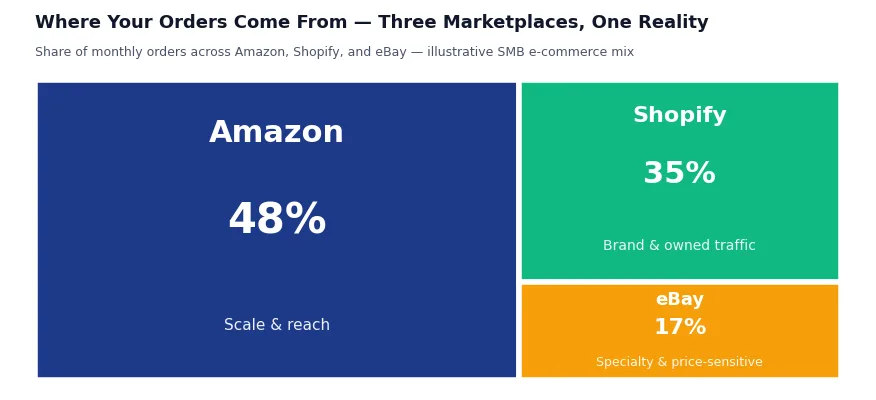
C'est précisément pour cela que vous devriez envisager d'adopter la meilleure plateforme en ligne pour les places de marché e-commerce, plutôt que de dépendre de feuilles de calcul et de multiples identifiants de connexion.
Quels problèmes un tableau de bord unique résout-il réellement
Disposer d'un tableau de bord centralisé n'est pas seulement une question de confort ; cela instaure un processus organisationnel beaucoup plus efficace pour l'ensemble de l'entreprise.
Visibilité claire des stocks
Les stocks d'Amazon, d'eBay et de Shopify peuvent être suivis ensemble. Cela garantit que les produits disponibles ne soient pas survendus et évite de mécontenter les clients.
Gestion des commandes
Votre équipe peut traiter tous les canaux depuis une interface unique au lieu de devoir les vérifier un par un. Cela rend le processus de préparation et d'expédition des commandes plus efficace et plus régulier.
Support client
Le fait de regrouper l'historique des commandes, le statut d'expédition et les informations de la plateforme simplifie grandement la manière dont l'équipe d'assistance traite les demandes.
Rapports et analyses
Avec un seul tableau de bord, vous pouvez facilement comparer les performances d'un canal à l'autre et identifier précisément d'où provient votre croissance.
La centralisation est la véritable clé si votre équipe souhaite gérer plusieurs places de marché sans subir les tracas du quotidien.
Comment eBay, Amazon et Shopify se complètent
Chaque plateforme répond à un objectif unique dans l'activité de votre boutique en ligne.
eBay
eBay a tendance à être une excellente option pour les prix compétitifs, les articles spécialisés et pour attirer les clients qui aiment chiner parmi un large choix de produits. C'est un bon moyen de tester la demande du marché.
Amazon
Amazon est généralement le moteur principal pour générer du volume et de l'envergure. On l'utilise pour maximiser la portée globale, mais cela exige également de la rapidité, une logistique irréprochable et un suivi rigoureux des indicateurs de performance.
Shopify
Shopify offre le plus haut niveau de contrôle sur l'expérience client, les données d'achat et le trafic propre. C'est bien souvent le fondement même de l'identité de votre marque.
Un système adapté est indispensable pour gérer les places de marché e-commerce en tirant parti des forces de chaque canal, plutôt que d'attendre qu'ils fonctionnent tous de la même manière.
Tableau 1 · Différences opérationnelles entre les trois places de marché — et ce que permet la centralisation
| Opération | Amazon | Shopify | eBay | AVANTAGE Avec le tableau de bord centralisé |
|---|---|---|---|---|
| Stock | Strict, quasi en temps réel ; les erreurs sont pénalisées | En temps réel via la plateforme que vous contrôlez directement | Au niveau de l'annonce ; nécessite souvent des ajustements manuels | Une seule source de vérité ; fin des ventes croisées excessives (surventes) |
| Commandes | Volume élevé, délais de livraison stricts (SLA), règles de transporteurs rigides | Flux interne propre ; vous contrôlez vos options logistiques | Volume plus faible ; attentes des acheteurs très variées | Toutes les commandes regroupées ; routage automatique selon la région et le coût |
| Messages clients | Messagerie intégrée à la plateforme, délais de réponse stricts | Communications directes et personnalisées (e-mail, chat sur site) | Messagerie intégrée à la plateforme, attentes de réponse plus souples | Boîte de réception unique ; historique complet de la commande associé à chaque ticket |
| Retours | Garantie de A à Z ; règles complexes selon la catégorie de produits | Contrôle total de la politique ; vous définissez le flux de travail | Règles de protection des acheteurs ; évaluation au cas par cas | Flux de retours unifié ; motifs catégorisés de manière omnicanale |
| Changements de prix | Dynamique algorithmique de la Buy-Box ; dictée par la concurrence | Campagnes de marque ; vous maîtrisez totalement vos offres promotionnelles | Modifications manuelles par annonce ; forte pression sur les prix | Synchronisation des prix sur tous les canaux ; pas de mauvaise surprise face à la concurrence |
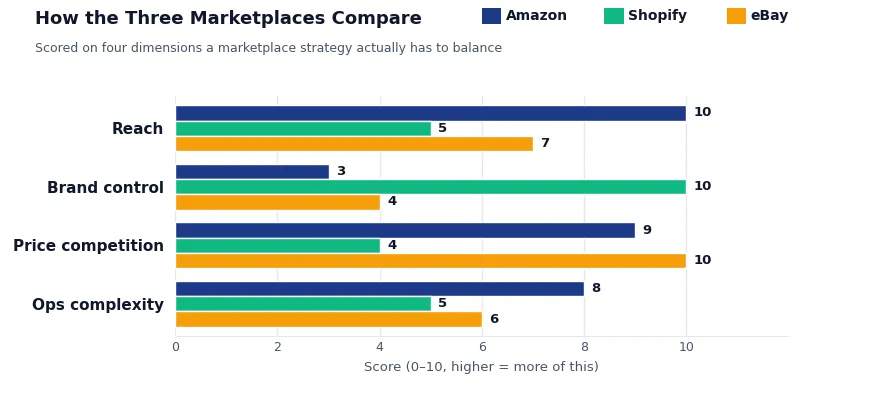
Il est utile de comprendre comment Shopify définit le commerce multicanal.
Ce qu'il faut rechercher dans un tableau de bord unifié
Tous les outils ne sont pas conçus pour offrir un contrôle authentique des places de marché. Un bon écosystème doit transmettre bien plus que de simples données chiffrées.
Les fonctionnalités incontournables
- Synchronisation des stocks en temps réel.
- Traitement centralisé des commandes.
- Consolidation des communications clients.
- Rapports détaillés au niveau de chaque canal.
- Règles d'automatisation pour le routage et les mises à jour.
- Intégration fluide avec vos outils logistiques et financiers.
Les meilleurs systèmes ne se contentent pas de collecter les données. Ils vous aident à prendre des mesures concrètes basées sur celles-ci.
Si vous souhaitez explorer une plateforme dédiée aux opérations connectées, découvrez ExactFlow.
Comment l'intelligence artificielle vous aide à grandir
L'intelligence artificielle automatise et rend la gestion des places de marché plus intelligente, et pas seulement plus rapide. Elle sait repérer des tendances, alerter sur des risques opérationnels et minimiser les tâches répétitives.
Des prévisions plus affinées
Grâce à l'IA, vous pouvez identifier les produits qui se vendent plus vite sur Amazon par rapport à votre boutique Shopify, ou repérer les annonces eBay qui ont besoin d'être optimisées pour générer des ventes avant d'expirer.
Un meilleur routage du support
Chaque question d'un client est classée par niveau d'urgence ou selon le canal d'origine, garantissant que la bonne équipe traite le bon problème en priorité.
Des décisions accélérées
L'IA permet aux équipes de réagir en temps réel aux variations de stock, aux retards d'expédition et aux fluctuations de la demande, réduisant ainsi la dépendance aux rapports manuels a posteriori.
C'est l'une des raisons pour lesquelles de nombreuses entreprises considèrent aujourd'hui un tableau de bord centralisé comme la solution e-commerce de pointe pour aborder les places de marché.
Utilisez la grille tarifaire de ExactFlow comme point de départ pour votre planification budgétaire et votre déploiement.
Construire un meilleur flux de travail pour vos places de marché
Pour tirer une valeur réelle d'un tableau de bord, la visibilité des données ne suffit pas ; vous devez structurer des flux de travail clairs.
1. Connectez vos canaux
Associez Amazon, eBay et Shopify au sein d'un unique système d'exploitation pour garantir que vos données résident dans une seule source centralisée.
2. Définissez des règles d'automatisation
Configurez des paramètres automatisés pour les niveaux de stock, le routage des commandes et les alertes afin d'alléger la charge de travail manuel de votre équipe.
3. Ne gérez que les exceptions
Déléguez le traitement des commandes courantes à l'automatisation, mais réservez l'intervention humaine pour le contrôle des marges, les questions clients complexes et autres anomalies.
4. Continuez à optimiser
Améliorez progressivement vos annonces, vos stratégies de prix et vos processus logistiques en exploitant les données de votre tableau de bord.
C'est ainsi que les équipes agiles et modernes gèrent aujourd'hui leurs places de marché e-commerce avec moins de complexité et un contrôle absolu.
Pour en savoir plus sur l'organisation qui conçoit ces flux de travail, visitez notre page Qui sommes-nous.
D'où provient l'efficacité réelle
Le plus grand avantage ne réside pas seulement dans l'économie de clics sur l'écran ; il consiste à réduire la charge mentale requise pour faire tourner l'activité.
Lorsque les informations sont dispersées, les équipes perdent un temps précieux à concilier les chiffres, à suivre les statuts et à corriger des erreurs qui auraient pu être évitées. Lorsque tout est regroupé au même endroit, les collaborateurs travaillent plus vite et prennent de meilleures décisions.
Cela devient crucial à mesure que vous développez votre présence multicanale et que vous cherchez à maintenir une logistique, un service client et des rapports financiers parfaitement alignés.
Un système connecté permet également aux dirigeants d'obtenir une vision beaucoup plus claire des performances globales de l'entreprise. Vous ne regardez plus des chiffres de ventes isolés, vous visualisez l'ensemble des opérations.
Conclusion
Vendre sur eBay, Amazon et Shopify ne doit pas signifier diriger trois entreprises distinctes. Avec le bon tableau de bord, vous pouvez unifier toutes vos opérations, réduire le travail manuel et structurer un système de gestion beaucoup plus fluide pour votre équipe. Si votre objectif est de gérer les places de marché e-commerce avec efficacité, les clés du succès sont la centralisation, l'automatisation et la visibilité des données.
Un tableau de bord robuste vous accompagne dans la gestion de vos canaux e-commerce en synchronisant les stocks, en rationalisant les commandes et en mettant à la disposition de chaque collaborateur l'information exacte dont il a besoin au même endroit. De plus, il facilite la détection précoce des incidents opérationnels et permet de croître en toute confiance.
ExactFlow aide les équipes e-commerce à unifier leurs canaux, à automatiser leurs flux de travail et à simplifier la gestion multicanale depuis une interface unique. Contactez-nous dès aujourd'hui.
Lorsque vos outils technologiques fonctionnent en parfaite synergie, votre équipe passe moins de temps à changer d'onglet et plus de temps à développer l'activité. C'est ce qui fait que la meilleure plateforme en ligne pour les places de marché e-commerce ressemble moins à un simple logiciel qu'à un véritable système d'exploitation pour la croissance.
Pour approfondir vos stratégies sur les places de marché, Amazon constitue une référence solide concernant les exigences des canaux de vente et le comportement des acheteurs.
Questions fréquentes
1. Quelle est la meilleure manière de gérer ensemble eBay, Amazon et Shopify ?
La méthode la plus efficace consiste à utiliser un seul tableau de bord centralisé qui synchronise automatiquement le stock, les commandes et les données clients sur les trois canaux simultanément.
2. Pourquoi est-il fondamental de gérer plusieurs places de marché à partir d'un système unique ?
Cela permet de limiter les erreurs opérationnelles, de gagner un temps précieux et d'aider les équipes à maintenir les prix, les niveaux de stock et la logistique alignés sur chaque canal.
3. Que dois-je rechercher dans la meilleure plateforme en ligne pour les places de marché e-commerce ?
Privilégiez la synchronisation des données en temps réel, des fonctionnalités d'automatisation poussées, des rapports centralisés et des intégrations directes avec vos outils logistiques et de support.
4. Comment les solutions e-commerce de pointe aident-elles les places de marché à se développer plus vite ?
Elles éliminent les tâches manuelles répétitives, améliorent la transparence des données et donnent aux équipes l'agilité nécessaire pour s'adapter rapidement aux changements du marché tout en restant parfaitement organisées.