
12 min de lecture
Gestion automatisée des commandes e-commerce : comment les agents IA éliminent le travail manuel
Par ExactFlow Team
17 mai 2026
Lorsque vous développez votre boutique en ligne, le véritable goulot d'étranglement ne se situe généralement pas au niveau du trafic, mais des opérations. Saisir manuellement les données des commandes dans des feuilles de calcul, passer des appels téléphoniques pour suivre les stocks, envoyer des e-mails pour coordonner les expéditions depuis les entrepôts et corriger les erreurs de livraison peuvent silencieusement consumer vos journées. C'est précisément dans ce domaine qu'intervient l'automatisation basée sur l'IA dans la gestion des commandes e-commerce.
Plutôt que de laisser votre équipe jouer les routeurs humains pour chaque commande, les agents d'IA peuvent gérer les tâches fastidieuses en arrière-plan, vous permettant ainsi de vous concentrer sur les produits, les clients et l'expansion.
Pourquoi la gestion des commandes devient un problème à mesure que vous grandissez
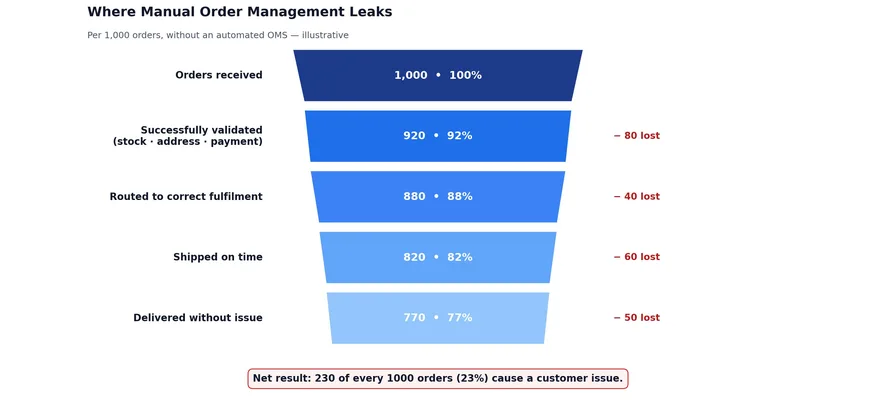
Il n'est pas difficile de gérer manuellement quelques commandes lorsque vous êtes une petite entreprise. Mais lorsque vous vendez sur plusieurs canaux — votre boutique, les places de marché (marketplaces) et le commerce social —, les processus manuels deviennent rapidement problématiques.
Vous commencez alors à constater :
- Des commandes qui passent entre les mailles du filet.
- Des ventes de stocks non disponibles (overselling) ou des marchandises qui dorment à l'entrepôt.
- Des étiquettes d'expédition générées en retard et des clients insatisfaits.
- Des heures perdues chaque semaine à faire des mises à jour manuelles de statut.
Un système moderne de gestion des commandes e-commerce est conçu précisément pour répondre à ces problèmes en connectant les données, les outils et les équipes en un seul endroit.
Pour obtenir une perspective plus large sur la complexité des commandes multicanaux, vous pouvez examiner comment Shopify décrit la gestion des commandes à travers les canaux de vente au sein de son propre écosystème.
Qu'est-ce que la gestion des commandes e-commerce pilotée par l'IA ?
Considérez la gestion des commandes e-commerce pilotée par l'IA comme un contrôleur de trafic intelligent pour toutes vos commandes entrantes. Au lieu de simplement « enregistrer » les commandes, le système :
- Envoie automatiquement chaque commande au bon entrepôt ou partenaire logistique (fulfillment).
- Vérifie l'inventaire et alerte en cas de problème avant qu'il ne survienne.
- Crée et met à jour les informations d'expédition de manière autonome.
- Met à jour le statut des commandes pour les clients et les canaux en temps réel.
Les agents d'IA surveillent les tendances (telles que les erreurs d'adresse fréquentes ou les problèmes de stock récurrents) et vous aident à éviter les anomalies plutôt qu'à devoir les résoudre une fois qu'elles ont échoué.
Tableau 1 · Le cycle de vie de la commande — approche manuelle vs approche par agent d'IA
| Étape | Approche manuelle | Approche par agent d'IA | Métrique clé à surveiller |
|---|---|---|---|
| 1 · RÉCEPTION | Copier manuellement les commandes depuis le tableau de bord de chaque canal vers un fichier central | Importation automatique depuis chaque canal via l'API dès que la commande est passée | Temps écoulé entre la commande passée et l'enregistrement dans le système |
| 2 · VALIDATION | Vérifier le stock, l'adresse et le paiement manuellement, commande par commande | Valide le stock, l'adresse et le paiement en quelques millisecondes ; signale les anomalies pour révision humaine | % d'erreurs de validation détectées à temps |
| 3 · ROUTAGE | Décider manuellement quel entrepôt ou prestataire logistique (3PL) traite chaque commande | Route les commandes par zone géographique, stock disponible et niveau de service via des règles configurables | Commandes acheminées vers le mauvais site |
| 4 · PRÉPARATION | Générer les étiquettes à la main, imprimer et confier aux transporteurs un par un | Génère automatiquement les étiquettes et choisit le transporteur optimal selon les coûts et l'historique des SLA | Temps écoulé entre la commande et l'étiquette d'expédition prête |
| 5 · SUIVI | Envoyer des e-mails de statut basés sur des modèles selon un calendrier ou à la demande | Pousse automatiquement des mises à jour en temps réel au client, au canal de vente et aux outils de support | Nombre de tickets « Où est ma commande ? » pour 100 commandes |
| 6 · EXCEPTIONS | Réagir après coup lorsqu'un client se plaint ou qu'un retour produit arrive | Signale les commandes risquées, bloquées ou anormales avant qu'elles n'échouent et fait ressortir les tendances | Problèmes détectés de manière proactive vs réactive |
Les avantages clés d'un système de gestion des commandes automatisé
1. Moins de travail manuel, moins d'erreurs
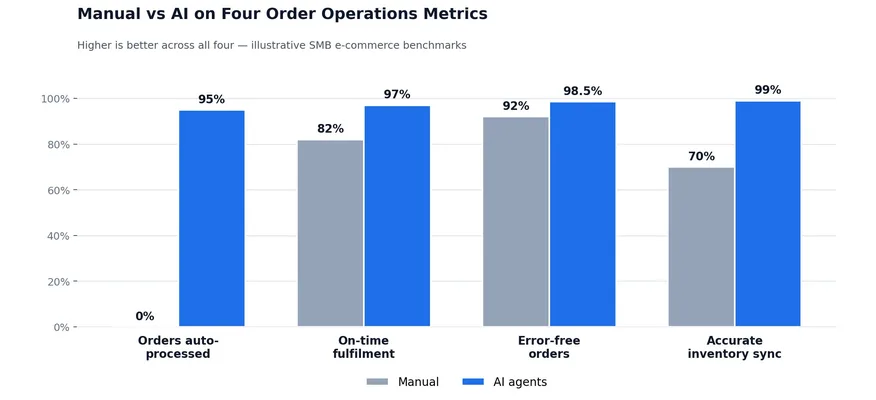
La saisie manuelle des données prend du temps et s'avère risquée. Un système de gestion des commandes e-commerce optimisé par l'IA est capable d'extraire les données de tous vos canaux de vente, de les normaliser et de les transmettre automatiquement aux applications d'expédition, d'inventaire et de comptabilité.
Cela se traduit par moins de saisie, moins d'erreurs lors de la prise de commande et un temps précieux économisé par votre équipe.
2. Exactitude des stocks en temps réel
La vente de produits non disponibles (overselling) génère de lourdes charges pour le support client et des remboursements frustrants. Comme votre logiciel de gestion des commandes e-commerce est étroitement connecté à votre inventaire, le niveau de stock est mis à jour dès qu'une commande est passée, annulée ou retournée.
L'IA est également en mesure de recommander des points de réapprovisionnement et d'identifier les produits à rotation rapide afin que vous ne tombiez pas en rupture de stock pendant les périodes de pointe.
3. Préparation des commandes plus rapide et prévisible
Les commandes sont traitées de manière rapide et uniforme grâce à l'utilisation d'agents d'IA pour assurer le routage et la génération d'étiquettes. Les clients disposent d'estimations de livraison et d'un suivi précis dès le départ, ce qui réduit les tickets du type « Où est ma commande ? » et renforce la confiance.
Ce qu'il faut rechercher dans une solution de gestion des commandes e-commerce
Tous les systèmes de gestion des commandes ne se valent pas. Lors de la sélection de votre solution de gestion des commandes e-commerce, tenez compte des critères suivants :
- Prise en charge multicanal : Elle doit pouvoir regrouper les commandes issues de votre site web, des places de marché et des réseaux sociaux de manière unifiée.
- Synchronisation des stocks : Des mises à jour en temps réel entre vos entrepôts, vos prestataires logistiques (3PL) et votre vitrine en ligne.
- Règles d'automatisation : Attribution automatique des commandes selon la région, le stock disponible à utiliser ou le niveau de service requis.
- Analyses par l'IA : Alertes en cas d'anomalies, de retards ou de tendances nécessitant une attention particulière.
Si vous souhaitez disposer d'un point central pour tout planifier, votre hub de gestion des commandes doit se situer au cœur de votre infrastructure logicielle et disposer d'un accès facile à vos autres outils, comme Stripe pour la réception des paiements.
Comment fonctionnent les agents d'IA en coulisses
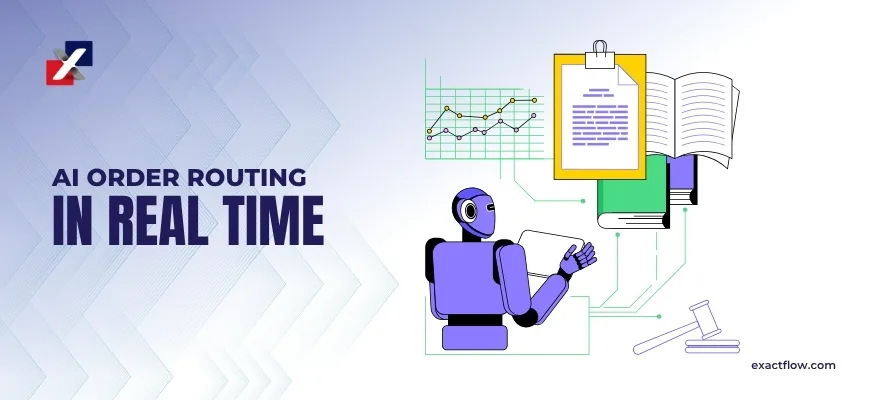
Les agents d'IA ne sont pas de simples macros sophistiquées. Ils s'enrichissent et apprennent en permanence à partir de vos données et de vos habitudes opérationnelles.
Ils peuvent notamment :
- Signaler les commandes qui semblent risquées (valeur élevée, comportements suspects, problèmes d'adresse récurrents, etc.).
- Recommander une optimisation des expéditions ou des regroupements de produits sur la base des performances historiques.
- Identifier les problèmes récurrents liés à un transporteur, un entrepôt ou une zone géographique en particulier.
- Suggérer des modifications de processus lorsque certaines exceptions deviennent trop courantes.
Grâce à cela, votre logiciel de gestion des commandes e-commerce devient plus intelligent au fil du temps plutôt que de rester statique.
Le meilleur système de gestion des commandes e-commerce en 2026
Lorsque les experts évoquent le meilleur système de gestion des commandes e-commerce en 2026, ils font généralement référence à celui qui fait si bien son travail qu'on remarque à peine sa présence.
« Le meilleur », en pratique, se traduit par :
- Des commandes qui convergent depuis tous vos canaux vers un tableau de bord unique et centralisé.
- Des alertes claires uniquement lorsqu'une intervention humaine est réellement indispensable.
- Une configuration simple des règles de gestion (sans nécessiter de codage complexe).
- Des performances fiables et stables pendant les grandes opérations commerciales et les pics saisonniers.
Il ne s'agit pas d'aligner une liste de fonctionnalités clinquantes, mais de s'assurer que le système élimine efficacement le travail manuel et vous aide à tenir vos promesses envers vos clients. Découvrez notre page À propos de nous.
Comment démarrer avec la gestion automatisée des commandes
Vous n'avez pas besoin d'une équipe de grande taille pour bénéficier de l'automatisation. Vous pouvez déployer la gestion des commandes e-commerce pilotée par l'IA étape par étape.
Étape 1 : Cartographiez votre processus actuel
Notez précisément comment circule une commande aujourd'hui, de l'achat jusqu'à la livraison. Identifiez les zones où :
- Vos collaborateurs copient manuellement des données entre les systèmes.
- Les erreurs se produisent le plus fréquemment.
- Les commandes prennent du retard ou se retrouvent bloquées.
Ces points constituent vos cibles prioritaires pour l'automatisation.
Étape 2 : Connectez vos outils principaux
Assurez-vous que votre système de gestion des commandes communique directement avec :
- Votre plateforme de e-commerce.
- Votre gestion d'inventaire/entrepôt ou prestataire 3PL.
- Vos outils d'expédition et transporteurs.
- Votre suite logicielle comptable ou financière.
Une fois ces connexions établies, l'IA peut transférer les données à la place de votre équipe afin de supprimer les interventions manuelles.
Étape 3 : Ajoutez des règles d'automatisation et exploitez les analyses de l'IA
Commencez par quelques règles simples :
- Router les commandes selon la zone géographique.
- Ajouter automatiquement un tag sur les commandes à forte valeur.
- Déclencher des alertes en cas de stock faible ou de pannes répétées.
Laissez ensuite l'IA mettre en lumière des tendances que vous n'auriez peut-être pas décelées — comme des transporteurs qui manquent fréquemment à leurs obligations de SLA ou des produits qui provoquent souvent des expéditions fractionnées (split shipments). Pour découvrir comment l'IA transforme chaque étape des opérations de vente en ligne, explorez ce guide complet de l'automatisation du e-commerce par l'IA et de la gestion évolutive des flux de travail en 2026.
Conclusion
À mesure que le volume de vos commandes augmente, votre capacité à évoluer ne dépend pas uniquement de vos efforts marketing, elle est étroitement liée à la fluidité de vos opérations. Une gestion automatisée des commandes e-commerce, propulsée par des agents d'IA, transforme la préparation logistique : d'un combat quotidien contre les imprévus, elle devient un processus prévisible et largement autonome.
En investissant dans une gestion intelligente de vos commandes e-commerce, vous réduisez la charge de travail manuel, limitez les erreurs et offrez à vos clients une expérience plus rapide et plus fiable, que vous gériez des dizaines de commandes par jour ou des milliers sur de multiples canaux.
ExactFlow accompagne les équipes e-commerce pour automatiser les flux de commandes, connecter les systèmes clés et s'appuyer sur des agents d'IA afin de maintenir des opérations fluides en arrière-plan. Contactez-nous dès aujourd'hui.
Lorsque vos opérations fonctionnent comme sur des roulettes, vous et votre équipe pouvez vous consacrer pleinement à la stratégie, à l'image de marque et à la relation client plutôt que de courir après les feuilles de calcul et les numéros de suivi.
FAQ
1. Qu'est-ce qu'un système de gestion des commandes pour le e-commerce ?
Un système de gestion des commandes utilisé par les marques de e-commerce est un logiciel qui centralise et regroupe les commandes de tous les canaux de vente, synchronise les stocks, route les ordres de préparation pour livraison, suit le statut de traitement et informe les clients — idéalement avec un minimum d'effort manuel.
2. En quoi un logiciel de gestion des commandes e-commerce se distingue-t-il d'une plateforme e-commerce classique ?
Votre plateforme e-commerce gère la vitrine de votre magasin et l'étape du paiement (checkout). Le logiciel de gestion des commandes e-commerce se concentre quant à lui sur tout ce qui se passe après la validation de la commande : le routage, la synchronisation des stocks, l'expédition et le reporting à travers plusieurs canaux et entrepôts.
3. À quoi dois-je m'attendre avec une solution de gestion des commandes e-commerce dotée d'une IA ?
Une solution de gestion des commandes e-commerce intégrant l'IA doit importer et standardiser automatiquement les commandes, détecter les anomalies de manière précoce, distribuer intelligemment les tâches et faire remonter des analyses précieuses sur les goulots d'étranglement, les alertes de stock et les performances des transporteurs.
4. Comment choisir le meilleur système de gestion des commandes e-commerce pour mon entreprise en 2026 ?
Pour choisir le meilleur système de gestion des commandes e-commerce pour vous en 2026, analysez vos canaux de vente actuels, votre infrastructure technologique (tech stack) et votre volume d'activité. Privilégiez les systèmes qui s'intègrent facilement, soutiennent votre modèle de préparation logistique, proposent une automatisation robuste et sont capables de grandir avec votre boutique au cours des prochaines années.