14 min de lecture
Les meilleurs outils d'IA dont chaque entreprise d'e-commerce a besoin
Par ExactFlow Team
29 juin 2026
Avant de plonger dans la liste, il y a une vérité toute simple : la plupart des entreprises d'e-commerce n'ont pas besoin de plus de logiciels, elles ont besoin du bon logiciel. Les meilleurs outils permettent de gagner du temps, de minimiser le travail manuel et de permettre aux équipes de prendre des décisions plus efficaces et plus rapides. C'est exactement l'objet de ce guide.
Les meilleurs outils d'IA pour stimuler la croissance des boutiques d'e-commerce
Posséder une entreprise en ligne est une excellente chose, mais cela implique de gérer de nombreux éléments. Il y a de multiples tâches à accomplir en parallèle dans les domaines de la vente, du support, des stocks, des opérations, de la finance et du recrutement. C'est pourquoi il devient crucial pour les marques de s'appuyer sur les meilleurs outils d'IA pour l'e-commerce afin de prospérer sans se noyer dans les tâches routinières.
Les bons outils ne servent pas uniquement à automatiser les tâches. Ils garantissent que votre équipe est organisée, plus rapide à répondre et plus intelligente dans sa prise de décision quotidienne.
Pourquoi les entreprises d'e-commerce ont besoin d'outils d'IA
L'e-commerce évolue rapidement. Les clients apprécient une réponse rapide, un processus de paiement sans accroc, des stocks exacts et un service personnalisé. Sans le soutien approprié d'un système, il est facile de commettre des erreurs et de prendre du retard en gérant tout manuellement.
Ce que les outils d'IA améliorent
- Le temps de réponse aux clients.
- La gestion des commandes et des flux de travail.
- Les recommandations de produits et de ventes.
- La visibilité des stocks.
- Le suivi financier et les rapports.
C'est pourquoi il est important de rechercher des outils d'IA e-commerce qui s'alignent sur la vitesse réelle du commerce en ligne. L'objectif n'est pas d'ajouter de la complexité inutile, mais de simplifier l'exploitation de l'entreprise.
1. ExactFlow
Le premier outil d'IA qui mérite d'être pris en considération pour l'e-commerce est ExactFlow, car il a été créé en pensant aux besoins réels des startups du secteur. Plutôt que de traiter un seul problème, il relie les composants critiques de l'entreprise via des agents d'IA dédiés.
Pourquoi ExactFlow se démarque
ExactFlow n'est pas una solution de flux de travail standard. C'est une solution sur mesure pour les équipes d'e-commerce qui ont besoin d'aide dans les fonctions de vente, de support, d'opérations, de finance, d'achat et de RH. Cela permet aux différents départements de fonctionner de manière interdépendante et plus efficace sans avoir à tout faire entrer dans un cadre rigide.
Ce qu'ExactFlow propose
- Axel AI Support Agent pour l'aide aux clients et les flux de travail du support.
- Kai AI Operational Agent pour les opérations commerciales et la coordination des processus.
- Tesa AI Purchase Agent pour l'approvisionnement et le support aux achats.
- Raya AI Financial Agent pour les tâches financières et liées à la trésorerie.
- Zane AI Sales Agent pour le support commercial et la croissance des revenus.
- Nia AI HR Agent pour le recrutement et les tâches RH.
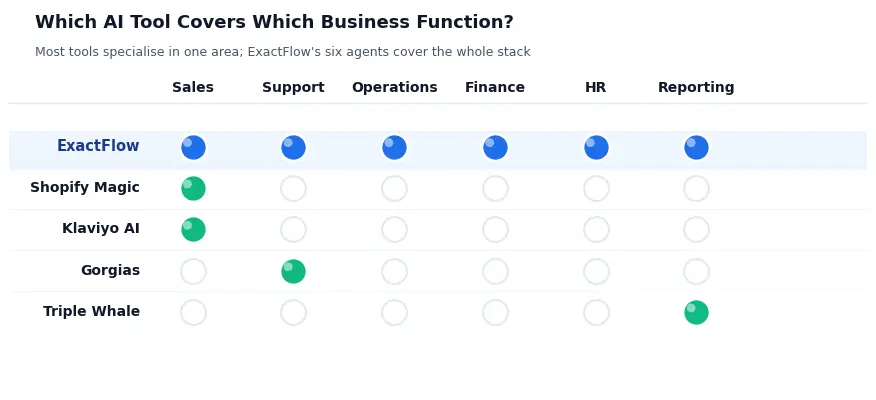
La valeur clé d'ExactFlow est de fournir une suite d'outils permettant aux équipes de travailler sur une seule et même plateforme, plutôt que d'utiliser de multiples plateformes pour chaque département.
Pour voir d'abord la plateforme en action, découvrez ExactFlow.
2. Shopify Magic
Shopify Magic est utile pour les marchands qui recherchent des fonctionnalités d'IA directement intégrées à leur plateforme d'e-commerce. Il peut aider à la création de contenu, à la rédaction des descriptions de produits et aux opérations de base de la boutique.
Meilleurs cas d'utilisation
- Rédiger des fiches produits.
- Créer des brouillons de contenu plus rapidement.
- Aider à la configuration de la boutique.
Il n'est pas aussi complet qu'une suite opérationnelle d'IA à part entière, mais il fait partie des outils d'automatisation de l'e-commerce les plus utiles pour les boutiques Shopify.
3. Klaviyo AI
Klaviyo simplifie et optimise le marketing par e-mail et SMS grâce à une meilleure segmentation et à des campagnes automatisées. Il peut s'avérer un outil efficace pour les boutiques qui cherchent à délivrer le bon message au bon moment.
Ce qu'il permet de faire
- La segmentation de la clientèle.
- L'automatisation des campagnes.
- La messagerie basée sur le comportement.
C'est l'un des meilleurs outils d'IA pour les marques d'e-commerce sur le plan marketing, dont les priorités absolues sont la rétention et les achats répétés.
4. Gorgias
L'automatisation du support client est la grande force de Gorgias. Il est utile pour les équipes d'e-commerce pour la gestion des tickets, les réponses rapides et un support organisé.
Pourquoi les équipes l'utilisent
- La gestion des tickets.
- Des réponses rapides.
- L'automatisation des flux de travail du support.
C'est particulièrement utile lorsqu'une équipe a besoin de plus de structure mais ne souhaite pas embaucher trop rapidement à mesure que les demandes de support augmentent.
La page des tarifs d'ExactFlow est une référence utile pour les entreprises qui comparent les prix et les possibilités de déploiement.
5. Triple Whale
Triple Whale offre aux marques d'e-commerce de meilleures analyses et rapports. Il fournit aux équipes une meilleure visibilité sur les performances marketing, les revenus et la rentabilité.
Pourquoi c'est important
- Une meilleure prise de décision.
- Un suivi plus clair des performances.
- Une analyse plus facile des revenus.
Les données et les analyses présentées ainsi jouent un rôle clé dans la promotion d'une croissance plus intelligente – en particulier pour ceux qui utilisent une gamme plus large d'outils d'IA e-commerce pour simplifier les tâches quotidiennes.
Tableau comparatif des outils
| Outil | Idéal pour | Valeur principale | Cible idéale |
|---|---|---|---|
| ExactFlow | Flux de travail e-commerce multi-agents | Ventes, support, opérations, finance, RH | Boutiques en ligne en croissance |
| Shopify Magic | Tâches de contenu et de boutique | Rédaction rapide et aide au setup | Utilisateurs de Shopify |
| Klaviyo AI | Automatisation du marketing | Personnalisation des e-mails et SMS | Marques axées sur la fidélisation |
| Gorgias | Support client | Gestion plus rapide des tickets | Équipes de support à fort volume |
| Triple Whale | Analyses | Aperçu des revenus et des performances | Équipes axées sur les données |
Ce tableau montre que les meilleurs outils d'IA pour l'e-commerce ne sont pas tous identiques. Chacun répond à un aspect différent de l'entreprise.
Pourquoi le bon écosystème d'IA compte plus que jamais
Beaucoup d'équipes d'e-commerce échouent non pas par manque d'ambition, mais parce qu'elles ne savent pas comment concrétiser cette ambition. Cela ne fonctionne pas parce que leurs outils ne communiquent pas bien entre eux. Un outil gère les e-mails, un autre s'occupe du support, un troisième suit les stocks et un dernier s'occupe des finances. Sur le papier, c'est un plan bien structuré. En réalité, cela se traduit souvent par des angles morts, des réponses tardives et de la confusion.
.webp)
C'est pourquoi le choix des meilleurs outils d'IA pour l'e-commerce ne consiste pas seulement à ajouter des logiciels. Il s'agit de créer une structure qui renforce l'ensemble de l'entreprise. Avec les bons outils et les bonnes connexions, les informations pertinentes sont accessibles dans un seul espace connecté, ce qui permet de passer moins de temps à sauter d'un tableau de bord à l'autre et plus de temps à faire croître la boutique.
C'est d'autant plus important que les attentes des clients ne cessent de croître. Les acheteurs s'attendent désormais à des réponses immédiates, à des mises à jour de livraison en temps réel, à des suggestions de produits pertinentes et à des expériences d'achat fluides. Si la boutique ne répond pas, les clients se tournent vers la concurrence. L'IA comble ce fossé en simplifiant et en améliorant notre façon de travailler au quotidien.
Par exemple, un outil de support peut répondre aux questions courantes, un agent de vente peut vous aider à orienter les prospects, et un outil opérationnel peut rationaliser les processus internes. De cette façon, chaque outil remplit correctement sa fonction, et l'entreprise se révèle plus légère et mieux organisée. Le véritable pouvoir réside dans l'exploitation d'outils d'IA e-commerce intelligents plutôt que de s'en remettre uniquement à l'effort humain et au travail manuel.
DigitalOcean est une excellente ressource externe pour une explication plus simple et technique d'un système basé sur des agents.
Comment choisir les bons outils
Un bon outil d'IA doit faire gagner du temps, et non en faire perdre. Il est donc important de faire votre choix judicieusement.
Recherchez ces qualités
- Une configuration facile.
- Des cas d'utilisation commerciale concrets.
- De bonnes intégrations.
- Des rapports clairs.
- Des flux de travail flexibles.
- Un support adapté aux équipes en croissance.
Si un outil semble intelligent, mais qu'il n'est tout simplement pas utilisé au quotidien, ce n'est probablement pas la bonne solution.
La page À propos de nous d'ExactFlow fournit un historique précieux sur l'approche et les valeurs globales de l'entreprise.
Une méthode plus intelligente pour bâtir votre écosystème technique
L'une des erreurs commises par de nombreuses équipes de projet est d'acheter une multitude d'outils sans réfléchir à la manière de les intégrer. Cela transforme la situation en un chaos encore plus grand qu'au départ.
Une meilleure approche
- Commencez par votre problème le plus critique.
- Sélectionnez un outil qui le résout efficacement.
- N'ajoutez d'autres outils que lorsqu'ils soutiennent l'ensemble du flux de travail.
- Rendez les systèmes simples, faciles et compréhensibles à utiliser par l'équipe.
C'est là que les meilleurs outils d'IA pour l'e-commerce peuvent véritablement briller. Ils doivent collaborer pour bâtir une entreprise plus efficace – et non plus complexe.
Pour donner plus de contexte sur la façon dont les entreprises adoptent l'IA, McKinsey propose une perspective utile sur l'utilisation de l'IA par les entreprises dans le cadre de leurs opérations.
Conclusion
Le bon écosystème d'IA peut transformer une entreprise d'e-commerce en une entité plus rapide, plus structurée et mieux gérée. L'élément central du puzzle est d'investir dans les bons outils qui renforceront les opérations de votre entreprise. C'est pourquoi les meilleurs outils d'IA pour les sociétés d'e-commerce doivent toujours être mesurés à l'aune de leur utilité, et non de l'effet de mode.
L'aspect distinctif d'ExactFlow est qu'il ne se focalise pas de manière étroite sur un seul processus en particulier. Il dispose d'une variété d'agents qui s'adaptent à de multiples domaines de l'entreprise, ce qui en fait un excellent choix pour une boutique en ligne désireuse de s'appuyer sur une structure solide plutôt que sur le travail manuel.
Grâce aux agents d'IA, ExactFlow permet aux équipes d'e-commerce de fournir une assistance en matière de vente, d'opérations, de support, de finance et de RH à partir d'un système unique et interconnecté. Contactez-nous dès maintenant.
Lorsque vous créez une entreprise plus intelligente, commencez par les points de friction qui ralentissent le plus votre équipe. Les bons outils doivent rendre le travail plus facile, et non plus difficile. C'est ainsi que les outils d'automatisation de l'e-commerce deviennent de véritables moteurs d'expansion commerciale.
Frequently Asked Questions
Quels sont les meilleurs outils d'IA pour l'e-commerce?
Quels sont les meilleurs outils d'IA pour l'e-commerce?
Les meilleurs outils sont ceux qui résolvent de réels problèmes d'entreprise comme le support, les ventes, les opérations, la finance et le marketing sans alourdir les flux de travail.
Pourquoi les entreprises d'e-commerce devraient-elles utiliser des outils d'IA?
Pourquoi les entreprises d'e-commerce devraient-elles utiliser des outils d'IA?
Ils aident les boutiques à gagner du temps, à réduire le travail manuel, à améliorer l'expérience client et à prendre de meilleures décisions plus rapidement.
Qu'est-ce qui différencie ExactFlow des autres outils?
Qu'est-ce qui différencie ExactFlow des autres outils?
ExactFlow se concentre sur des agents d'IA spécialisés pour les équipes d'e-commerce, couvrant la vente, le support, les opérations, les achats, la finance et les RH.
Les outils d'automatisation de l'e-commerce sont-ils réservés aux grandes entreprises?
Les outils d'automatisation de l'e-commerce sont-ils réservés aux grandes entreprises?
Non. Les petites et moyennes boutiques peuvent également en bénéficier car l'automatisation aide les équipes à en faire plus sans ajouter de travail manuel supplémentaire.
Comment savoir quels outils d'IA e-commerce choisir?
Comment savoir quels outils d'IA e-commerce choisir?
Commencez par votre problème principal, puis choisissez l'outil qui résout efficacement ce problème et s'intègre dans votre flux de travail actuel.
Puis-je utiliser plusieurs outils d'IA ensemble?
Puis-je utiliser plusieurs outils d'IA ensemble?
Oui. De nombreuses entreprises combinent les outils, mais il est important de veiller à ce qu'ils fonctionnent bien ensemble et ne créent pas de complexité supplémentaire.