
12 min de lecture
Comment automatiser la gestion des commandes avec l’IA
Par ExactFlow Team
25 mai 2026
Avec l'essor des boutiques en ligne, la gestion des commandes devient rapidement l'un des aspects les plus complexes de la gestion d'une entreprise. Ce qui semble être un processus simple peut vite se transformer en un cauchemar quotidien : importations de commandes, modifications des stocks, vérifications des expéditions, remboursements et e-mails clients. C'est pourquoi de plus en plus de marques se tournent vers la gestion des commandes e-commerce pour éliminer le travail manuel et garantir l'efficacité de leurs opérations.
C'est l'intelligence artificielle qui change véritablement la donne ici, en transformant les tâches répétitives en processus intelligents et automatisés qui s'exécutent en arrière-plan. Grâce à cela, votre équipe peut résoudre les problèmes de routine en quelques heures et se concentrer plutôt sur les clients, la stratégie et la croissance.
Qu'est-ce que la gestion des commandes e-commerce ?
La gestion des commandes e-commerce est, par essence, le processus de réception, de suivi, de préparation et de mise à jour des commandes des clients à travers vos différents canaux de vente. Elle englobe tous les aspects du processus qui commence dès qu'un utilisateur clique sur le bouton d'achat et se termine lorsque le colis est reçu et accepté.
Un système de gestion des commandes (OMS) dédié aux marques e-commerce ne doit pas se contenter d'archiver les informations de commande ; il doit aller bien au-delà. Il doit centraliser les ventes, les stocks, l'expédition et la communication client en un seul endroit pour vous aider à gérer votre activité plus rapidement et avec un minimum d'erreurs.
Lorsque l'IA est intégrée à cet écosystème, elle rend le processus encore plus intelligent. Le système peut identifier des schémas, orienter automatiquement les tâches et signaler les anomalies avant qu'elles n'affectent l'expérience client.
Pour acquérir une compréhension plus large des principes fondamentaux du flux de commandes, il sera utile de consulter la manière dont Shopify décrit le traitement des commandes dans l'e-commerce.
Pourquoi la gestion manuelle des commandes ralentit votre activité
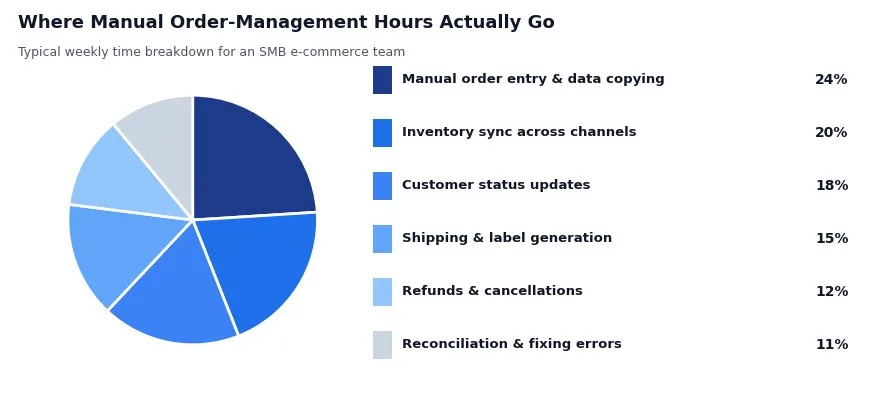
De nombreuses entreprises gèrent encore leurs commandes à l'aide de feuilles de calcul, d'e-mails et d'outils isolés. Cette approche peut convenir à très petite échelle, mais elle échoue complètement dès que les ventes commencent à augmenter.
Problèmes courants liés au travail manuel :
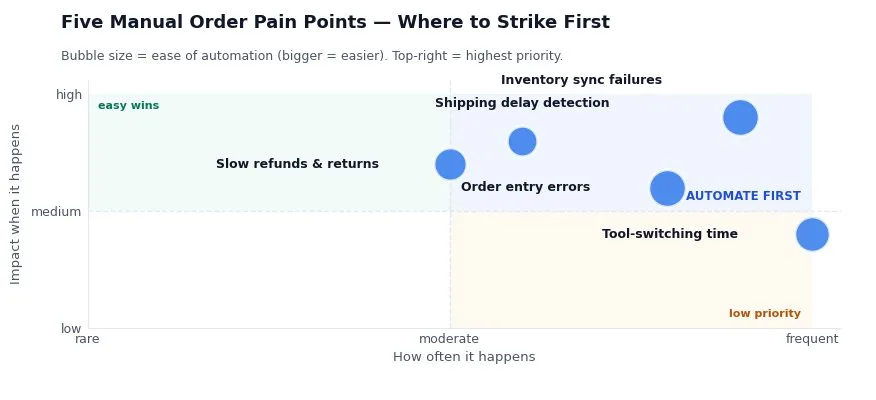
- Erreurs de saisie ou de copie des données de commande.
- Mises à jour des stocks déconnectées des ventes réelles.
- Retards d'expédition non détectés avant que le client ne s'en plaigne.
- Processus d'annulation et de remboursement extrêmement chronophages.
- Perte de temps pour les équipes qui basculent d'un outil à l'autre au lieu de résoudre les vrais problèmes.
Ces frictions opérationnelles expliquent précisément l'importance cruciale d'un système de gestion des commandes e-commerce. Le bon outil élimine les points de blocage à chaque étape et maintient la synchronisation de tous les éléments mobiles.
Comment l'IA automatise la gestion des commandes
L'IA ne se contente pas d'informatiser le processus, elle l'optimise et le fait évoluer. Un système de gestion des commandes e-commerce performant intègre l'IA pour surveiller les changements, réagir aux événements et agir avec une intervention humaine minimale, voire inexistante.
1. Routage automatique des commandes
Dès qu'une nouvelle commande est reçue, l'IA est capable de l'orienter intelligemment en fonction de l'emplacement des stocks, de la rapidité de livraison, de la zone géographique du client ou des coûts. Cela se traduit par une exécution plus rapide et une baisse drastique des erreurs.
2. Synchronisation des stocks en temps réel
L'IA met à jour les données de stock sur tous les canaux instantanément après chaque vente. Cela permet d'éviter les risques de survente, les ruptures de stock et la situation inconfortable consistant à annoncer à un client que son produit est indisponible alors qu'il a déjà payé.
3. Gestion intelligente des exceptions
Si un événement anormal survient (une commande suspecte, une baisse critique des stocks ou un échec de livraison), l'IA peut déclencher immédiatement une alerte. Cela donne à votre équipe le temps nécessaire pour intervenir là où le jugement humain est indispensable.
C'est là que réside la véritable puissance de la gestion des commandes e-commerce : une automatisation qui ne vise pas seulement la vitesse, mais qui réduit les erreurs et maximise la satisfaction client. Découvrez les détails de nos tarifs.
Les avantages d'un système de gestion des commandes automatisé
Traitement plus rapide
Un système de gestion des commandes automatisé pour les entreprises d'e-commerce traite les demandes de manière quasi instantanée, accélérant le passage du paiement à l'expédition tout en améliorant l'expérience client globale.
Réduction des erreurs
La saisie manuelle des données ouvre la porte aux erreurs humaines. L'automatisation élimine ces risques en garantissant que les données de commande, les informations clients et les détails d'expédition restent parfaitement cohérents sur tous les systèmes.
Meilleure communication client
Grâce à un suivi précis des commandes, les clients reçoivent des mises à jour fiables et instantanées sans avoir à attendre une réponse du support. Cela réduit les demandes du type « Où est mon colis ? » et renforce la confiance envers votre marque.
Scalabilité simplifiée
Les processus manuels ne peuvent pas tenir la cadence face à une augmentation du volume des commandes. L'infrastructure indispensable pour croître sans multiplier indéfiniment vos effectifs repose sur un système solide de gestion des commandes e-commerce.
Pour les marques qui souhaitent automatiser l'intégralité de leur écosystème e-commerce, la plateforme Google Cloud propose des ressources précieuses sur les opérations commerciales basées sur l'IA.
Que devez-vous rechercher dans un système de gestion des commandes e-commerce de confiance ?
Toutes les plateformes ne se valent pas. Lors du choix de votre solution de gestion des commandes e-commerce, privilégiez les fonctionnalités qui soutiennent une croissance concrète sur le terrain.
Les fonctionnalités clés à cibler :
- Synchronisation des commandes omnicanale (Multi-Channel).
- Mises à jour des stocks en temps réel.
- Règles automatisées pour la préparation des commandes (Fulfillment).
- Intégration avec les transporteurs et les services logistiques.
- Flux de travail automatisés pour les notifications clients.
- Rapports détaillés et alertes en cas d'exceptions.
Les meilleurs outils doivent simplifier vos opérations, pas les complexifier. Si une plateforme s'avère trop lourde à gérer, l'automatisation perd tout son intérêt. Pour plus de détails, visitez notre page À propos.
Tableau 1 · Système de gestion des commandes - Liste de contrôle de l'acheteur
| Fonctionnalité | Ce qu'elle fait réellement | Pourquoi c'est important | Signal d'alarme : ce qu'il faut surveiller |
|---|---|---|---|
| Synchronisation multi-canal | Regroupe les commandes de chaque boutique en ligne, place de marché et canal social dans un tableau de bord unique | Plus besoin de fusionner des fichiers CSV chaque semaine ; aucune commande ne s'égare | La mention « Bientôt disponible pour la plateforme X » signifie que vous continuerez à faire des copier-coller manuels pour ce canal |
| Stocks en temps réel | Met à jour les quantités disponibles partout en quelques secondes après chaque vente, retour ou transfert de produit | Élimine définitivement la survente et les e-mails d'excuses embarrassants pour cause de rupture de stock | « Mise à jour toutes les 15 minutes » n'est pas du temps réel — vous risquez de vendre le même produit deux fois durant cet intervalle |
| Règles d'exécution automatisées | Oriente chaque commande vers l'entrepôt ou le prestataire logistique (3PL) idéal en fonction de la zone, du stock ou du niveau de service | Garantit l'expédition la moins chère et la livraison la plus rapide sans tri manuel | « Règles fixes et rigides uniquement » — les besoins de votre entreprise dépasseront ces limites en moins d'un trimestre |
| Intégration transporteurs & logistique | Génère les étiquettes de transport, transmet le suivi et synchronise le statut de livraison avec la commande automatiquement | Pas d'impression manuelle, pas de saisie de bordereaux, et plus de discussions interminables pour savoir « si c'est parti » | Seulement deux transporteurs pris en charge — ce qui vous rend dépendant de leurs tarifs sans autre alternative |
| Flux de notifications clients | Envoie automatiquement les mises à jour de commande, d'expédition et de retard par e-mail et SMS | Baisse massive des tickets de support liés au suivi de colis et nette augmentation de la confiance client | « Modèles figés sans embranchements intelligents » — les messages semblent génériques, froids et purement robotiques |
| Rapports et alertes d'exceptions | Met en lumière les commandes bloquées, les anomalies et les dépassements de délais (SLA) avant que le client ne s'en aperçoive | Votre équipe intervient exclusivement sur les cas qui requièrent une réelle expertise humaine | « Synthèse par e-mail une fois par jour » — ce n'est pas un système d'alerte, c'est juste un journal d'information tardif |
Vous devez également vous assurer que votre système s'intègre parfaitement aux autres outils de votre écosystème technique, tels que les logiciels d'expédition, les CRM et les outils d'analyse. C'est à ce niveau qu'une plateforme connectée de gestion des commandes e-commerce prend tout son sens pour devenir le cœur de vos opérations.
Si vous comparez les plateformes d'automatisation, il est intéressant d'étudier comment Zapier détaille l'automatisation des flux de travail entre différentes applications.
Comment vous lancer ?
Nul besoin de tout automatiser dès le premier jour ; la stratégie la plus efficace consiste à commencer par les tâches les plus répétitives et chronophages pour votre équipe.
Étape 1 : Cartographier votre processus actuel
Notez précisément comment une commande transite aujourd'hui à travers votre système. Identifiez l'emplacement des goulets d'étranglement, des erreurs et des validations manuelles.
Étape 2 : Repérer les opportunités d'automatisation
Ciblez des tâches récurrentes telles que :
- L'importation des commandes
- Les mises à jour d'expédition
- La synchronisation des stocks
- Les déclencheurs de remboursement
- Les notifications aux clients
Ces étapes constituent généralement les points d'entrée les plus simples pour intégrer l'intelligence artificielle.
Étape 3 : Déployer et tester vos flux de travail
Commencez modestement : automatisez un seul processus, analysez les résultats, puis passez à l'étape suivante. Cette méthode vous permet d'ajuster le système en continu sans surcharger vos collaborateurs.
La gestion des commandes n'est qu'une pièce d'un puzzle d'automatisation bien plus vaste. Si vous souhaitez découvrir comment l'IA aide les marques e-commerce à optimiser la logistique, les stocks, les parcours clients et la gestion quotidienne, consultez notre guide complet de l'automatisation e-commerce propulsée par l'IA en 2026.
Conclusion
L'IA redéfinit en profondeur la gestion opérationnelle des boutiques en ligne en rendant la gestion des commandes e-commerce plus rapide, plus fluide et nettement moins stressante. Au lieu de traiter les problèmes de manière réactive les uns après les autres, les entreprises peuvent bâtir des architectures automatisées qui gèrent les tâches courantes en arrière-plan pendant que les équipes se consacrent pleinement au développement.
Une stratégie de gestion des commandes e-commerce bien pensée vous permet de réduire les erreurs manuelles, d'accélérer les délais de livraison et d'offrir une expérience client irréprochable à chaque étape du parcours.
ExactFlow aide les marques e-commerce à automatiser leurs flux de commandes, à interconnecter leurs systèmes et à maintenir une fluidité opérationnelle maximale avec un minimum d'efforts manuels. Contactez-nous dès aujourd'hui.
Le véritable bénéfice de l'automatisation ne se limite pas au temps gagné ; il s'agit de bâtir une entreprise capable de franchir des paliers de croissance en toute sérénité. Lorsque vous appuyez vos opérations sur un système de gestion des commandes e-commerce fiable, vous gagnez en contrôle, en visibilité et vous posez des fondations solides pour l'avenir.
Foire Aux Questions (FAQ)
1. Qu'est-ce que la gestion des commandes e-commerce ?
La gestion des commandes e-commerce désigne le processus de suivi, de préparation et de mise à jour des commandes clients sur l'ensemble de vos canaux de vente. Elle relie la prise de commande, l'inventaire, la logistique et la relation client au sein d'un flux de travail unifié.
2. Comment un système de gestion des commandes améliore-t-il l'efficacité des marques e-commerce ?
Un système de gestion des commandes e-commerce accroît l'efficacité en automatisant les tâches répétitives (routage des commandes, mise à jour des stocks, alertes d'expédition). Cela réduit le travail manuel et permet aux équipes de traiter de plus grands volumes avec moins d'erreurs.
3. Qu'attendre d'un bon système de gestion des commandes e-commerce ?
Un outil performant doit centraliser les commandes omnicanales, synchroniser les stocks en temps réel, prendre en charge l'automatisation de la logistique et fournir des rapports transparents pour réagir immédiatement en cas d'anomalie.
4. Pourquoi la gestion des commandes e-commerce est-elle cruciale pour le développement d'une activité ?
Elle est essentielle car elle offre une structure reproductible et évolutive capable d'absorber une hausse d'activité sans générer de charge de travail manuel supplémentaire. Cela vous permet de vous développer tout en maintenant des opérations fluides et qualitatives pour vos clients.