
12 min read
AI vs Manual E-commerce Management: Which One Wins?
Von ExactFlow Team
3. Juni 2026
Running an online store is no longer just about listing products and waiting for sales. It's all about managing the behind-the-scenes operations: inventory, orders, customer queries, reports, fulfilment, and marketing. So, e-commerce management is one of the crucial factors in determining whether a store will grow steadily or be forced to fight fires all the time.
The question becomes, 'Use AI or do it the manual way?' It all comes down to your priorities, but there's a huge chasm between the two approaches.
What E-commerce Management Looks Like Today
Today's e-commerce management is much more than just publishing products and responding to emails. It covers order routing, inventory sync, customer support,sales operations,financial tracking, and even how quickly teams can react to changes in demand.
In a small store, manual processes may still feel manageable. However, as orders grow, manual processes slow down, cost more, and have more errors.
For more on automation in retail operations, see how Shopify breaks down commerce workflows and automation.
Manual E-commerce Management: The Old Way
Manual e-commerce management most commonly involves employees copying information between systems, addressing every problem manually, and making decisions based on spreadsheets or emails. It might be fine in the beginning, but then it slows to a standstill.
Common manual tasks
- Copying orders into fulfilment systems
- Updating stock levels after sales
- Answering frequently asked questions
- Generating reports from multiple systems
- Noticing any shipping delays or missing orders
It isn't that humans aren't good at doing these things. The problem is that managing e-commerce is not easy when done by hand. As the volume increases, the possibility of mistakes, hold-ups, and exhaustion looms.
AI in E-commerce Management: The New Standard
The use of AI in e-commerce management involves having smart systems to perform routine tasks, detect patterns, and facilitate quicker decision-making. Rather than people having to point out every problem, AI can constantly watch the data and check if anything changes.
This is a big transformation in e-commerce management because it shifts the business automatically from reactive to proactive.
What AI can do
- Automatically distribute orders to the right warehouse or 3PL.
- Control stock risk and prevent stockouts.
- Send customer notifications for shipping changes.
- Identify anomalies and fraudulent orders.
- Suggest next steps for operations and support teams.
This kind of AI e-commerce management helps support teams do more with less while working with a growing number of customers and complexity.
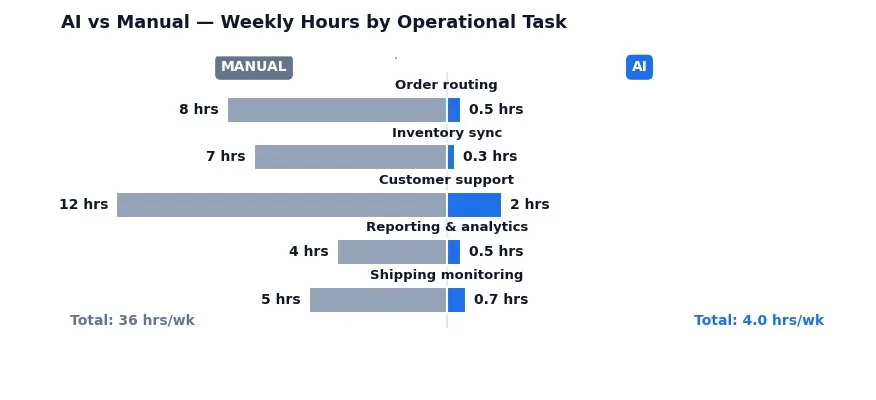
To learn about how AI is changing operations in different sectors, read more about AI-enabled business transformation at McKinsey.
Automated vs Manual E-commerce Operations
Automated vs manual e-commerce operations are easy to compare.
Speed
Manual work depends on people being available and focused. AI never sleeps, so things like routing, synchronization, and notifications occur in real time.
Accuracy
Humans are not perfect, particularly when they do the same task day in and day out. AI makes data entry more accurate and systems more consistent.
Scalability
Manual processes are not scalable. AI allows e-commerce management to be scaled more easily without requiring a proportionate increase in human resources.
Flexibility
Human teams may be creative, but it takes time. AI gives people more time by handling the boring, repetitive stuff.
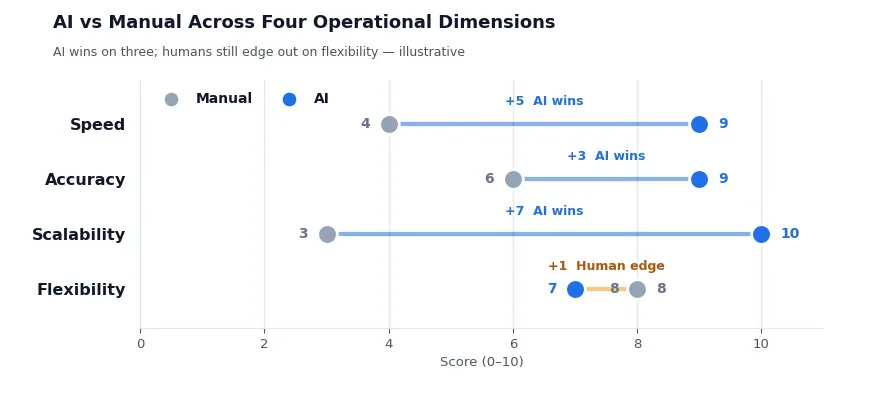
The real trick isn't about using AI everywhere; it's about finding the right balance. Let the machines take care of the routine work, and leave the tricky, unique situations to the people who can think outside the box.
Where Manual Still Helps
Although we hear about the growth in AI, we still need manual skills.
Human judgment matters
Complicated customer problems, branding issues and rare exceptions may require humans. A smart system might recognise the issue, but humans should typically make the final decision.
Creative strategy needs people
People are better at generating campaign ideas, brand messaging, building relationships and negotiating high-value partnerships. Often, AI makes these tasks faster by automating the surrounding work.
So the best e-commerce platform is not fully automated. It is useful automation with human supervision.
Table 1 · The hybrid e-commerce management model — what AI handles, what humans handle, and where they hand off
| Function | AI handles | Human handles | Trigger for escalation |
|---|---|---|---|
| Order processing | Validates, sends to warehouse, makes labels, adds tracking | Approves high-value orders, clearing up any shipping irregularity | Order continues > $X, Fraud Signal, Repeated Address Mismatch |
| Inventory & stock | Live sync across channels, triggers reorders and spots unusual activity | Confirms reorder quantities, selects new suppliers | Change in stock anomaly, new SKU introduction, change the supplier |
| Customer support | Chat is available 24/7 for frequently asked questions, checking order status and simple returns | Handling complaints, VIP customers, sensitive issues | Detected negative sentiment, multiple-issue ticket |
| Refunds & returns | Handle routine refunds and sort out why returns happen | Managing edge cases, suspect fraud and goodwill decisions | Refund is greater than threshold, suspicious return pattern |
| Marketing & campaigns | Behavior triggered flows, segmentation, A/B test segments | Creative concepts, brand voice, moments for a big campaign | A new campaign concept or redesigning of the positioning of the brand |
| Vendors & partnerships | Monitors performance, alerts on SLA violations, generates reports | Negotiating, building relationships, and making contract decisions | A drop in performance and the time to renew a contract |
Why AI Wins in Most E-commerce Management Scenarios
For day-to-day operations, AI usually has the advantage.
1. Less repetitive work
AI eliminates hours of tedious work for your team. Now there is more time for building strategy and growth and serving customers.
2. Faster decision-making
AI surfaces what matters in real time instead of waiting for a weekly report. So your team can respond quickly to low stock, slowed fulfilment or an opportunity to boost sales.
3. Better customer experience
An efficient, accurate back-end serves customers better. Orders process more quickly, feedback is more timely, and responses are more predictable.
4. More consistent operations
AI allows consistency across teams and channels, which is huge for scaling your e-commerce operations.
Building a Smarter Management Stack
If you are ready to start moving from manual to more automated work, it's best to begin with repetitive tasks.
Look for AI-ready tools
Select a system that integrates with your storefront, warehouse, CRM and support tools. The ideal AI stack makes e-commerce management easier.
Start with one workflow
Start with just one process (like order processing or stock alerts). Once that works well, expand into support, reporting, and sales workflows.
Measure the impact
You'll measure the time saved, reduced errors, response time and fulfilment accuracy. These metrics will confirm if your AI journey is on track.
For a more complete picture of how automation is transforming business, check out HubSpot resources on workflow automation and AI in business.
Conclusion
For stores that are getting bigger, the question of using artificial intelligence or doing things manually has a clear answer: Artificial intelligence is better when it comes to doing things fast, being efficient and being precise, but people are still needed to make good decisions, be creative and handle special cases. These days, the people in charge of stores are not just choosing one or the other: they use artificial intelligence to do the everyday work and people to do the work that really needs a human touch.
If you think of running a store as a whole system rather than just a bunch of separate tasks, it is clear where automation can make things easier, reduce stress and improve everything about how the store runs.
ExactFlow can help companies put all their work together and automate the things they do every day, and use artificial intelligence to make running a store faster, easier and more efficient. Contact Us now.
The people who will be in charge of stores in the future are the ones who can embrace the efficiency of AI and the wisdom of people to build a sustainable model that works now and scales up in the future.
Frequently Asked Questions
What is the biggest difference between AI and manual e-commerce management?
What is the biggest difference between AI and manual e-commerce management?
The biggest difference is the scale of e-commerce management. When you set up e-commerce management, it requires people to do a lot of tedious work, task by task. On the other hand, AI does the work continuously, and it does it much faster.
Is AI in e-commerce management hard to implement?
Is AI in e-commerce management hard to implement?
It is not necessarily. Many businesses start with one thing, such as routing orders or sending customer notifications, and then they expand to other areas. The key to implementing AI in e-commerce management is to choose tools that fit your workflow and support gradual adoption.
What parts of manual e-commerce management should be automated first?
What parts of manual e-commerce management should be automated first?
The best things to start with are error-prone tasks like updating inventory, order status notifications and generating reports. These tasks are usually the easiest to automate with AI in e-commerce management.
Will AI replace manual e-commerce management completely?
Will AI replace manual e-commerce management completely?
No, AI is best used to reduce the amount of work and improve consistency in e-commerce management. Human oversight is still important for handling exceptions, developing strategy, building customer relationships and making decisions that require good judgment.