10 min de lecture
Chatbots IA vs Agents IA : Quelle est la différence ?
Par ExactFlow Team
8 juin 2026
Les sites de commerce électronique intègrent l'automatisation intelligente plus rapidement que jamais. Pourtant, de nombreuses équipes hésitent encore entre l'utilisation de chatbots IA et d'agents IA, deux outils aux fonctions bien distinctes. Apprendre à appliquer le bon outil au bon moment peut améliorer l'expérience client, rationaliser les opérations et personnaliser le parcours d'achat.
Comprendre les outils d'IA qui parlent, agissent et convertissent
En termes simples, les chatbots répondent et guident, tandis que les agents agissent et accomplissent des tâches. Cette distinction est essentielle lorsqu'il s'agit de choisir l'IA adaptée au commerce électronique.
Que sont les chatbots IA ?
Il s'agit de programmes capables de converser avec les clients, généralement par texte. Un chatbot peut répondre aux questions courantes, aider les visiteurs à trouver des produits et les diriger vers la bonne page ou le bon canal d'assistance.
Les chatbots sont généralement conçus pour la rapidité et l'efficacité. Ils sont excellents pour gérer les demandes récurrentes concernant la livraison, les retours, la disponibilité des produits et le statut des commandes. Ils sont donc parfaits pour traiter un grand nombre de conversations rapidement.
Microsoft Copilot donne un aperçu rapide des différences entre les chatbots et les agents IA et explique pourquoi cela est important.
Comment fonctionnent les chatbots IA ?
Ils s'appuient sur des règles, des modèles linguistiques et, dans certains cas, sur la recherche d'informations pour évaluer ce qu'un utilisateur leur dit et lui fournir la réponse la plus efficace. Les chatbots simples fonctionnent sur la base d'arbres de décision, tandis que les plus complexes utilisent l'intelligence artificielle pour interpréter le langage naturel et répondre en conséquence.
Voici comment fonctionne généralement un chatbot :
- L'utilisateur envoie une question.
- Le système identifie l'intention (Intent).
- Il renvoie une réponse pré-écrite ou générée par l'IA.
- Si nécessaire, il transfère l'utilisateur vers un conseiller humain.
Les chatbots sont donc parfaits pour le support client, les questions fréquemment posées et d'autres interactions avec les clients où la réactivité est plus importante que l'action concrète.
Que sont les agents IA ?
Les agents IA sont des systèmes intelligents capables de faire bien plus que répondre à des questions. Ils peuvent accomplir des tâches, prendre des décisions (dans la limite de certains paramètres) et exécuter des actions pour le compte de l'utilisateur ou de l'entreprise.
Par exemple, les agents IA peuvent :
- Suivre le statut d'une commande et en informer le client.
- Prioriser et attribuer un ticket d'assistance.
- Déclencher des flux de travail (workflows) dans votre outil de gestion client.
- Assister un commercial en rédigeant des e-mails de suivi ou en suggérant des actions futures.
Contrairement aux chatbots, les agents sont conçus pour être opérationnels. C'est pourquoi ils sont fréquemment utilisés dans les flux de travail du e-commerce, où les actions de l'agent sont tout aussi cruciales pour l'entreprise que la conversation elle-même.
DigitalOcean propose un aperçu de la manière dont les agents IA gèrent des tâches plus complexes que les chatbots. Si vous êtes curieux de savoir comment se présente une solution de support IA pour le e-commerce, découvrez l'Axel AI Support Agent d'ExactFlow.
Chatbots IA vs Agents IA en pratique
C'est ici que la différence entre chatbots IA et agents IA dépasse la simple question de sclémantique.
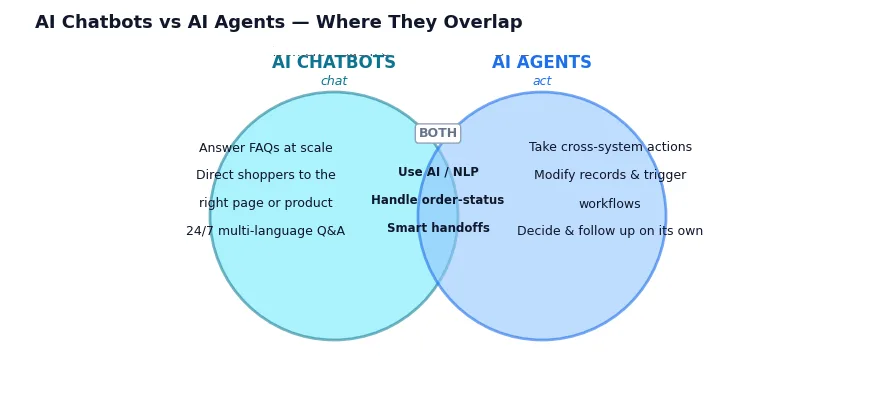
Les chatbots sont parfaits pour :
- Répondre aux FAQ.
- Diriger les utilisateurs vers la bonne page.
- Recueillir des informations simples.
- Répondre aux questions d'assistance fréquentes.
Les agents IA sont parfaits pour :
- Accomplir des tâches.
- Connecter des systèmes entre eux.
- Recommander les prochaines actions.
- Gérer des tâches nécessitant du contexte et une prise de décision.
Voici la différence : les chatbots discutent avec les clients, tandis que les agents prennent des mesures concrètes. C'est pourquoi les chatbots IA et les agents IA peuvent intervenir à différentes étapes d'une même interaction digitale.
Si vous recherchez une solution pour intégrer l'IA dans plusieurs domaines de votre entreprise, découvrez la plateforme d'ExactFlow.
Pourquoi cette différence est cruciale pour le e-commerce
Les équipes de e-commerce ont souvent besoin à la fois de dialogue et d'action. Un chatbot peut aider un acheteur à comparer des produits, mais un agent peut également vérifier les stocks, traiter une demande ou faire avancer un flux de travail.
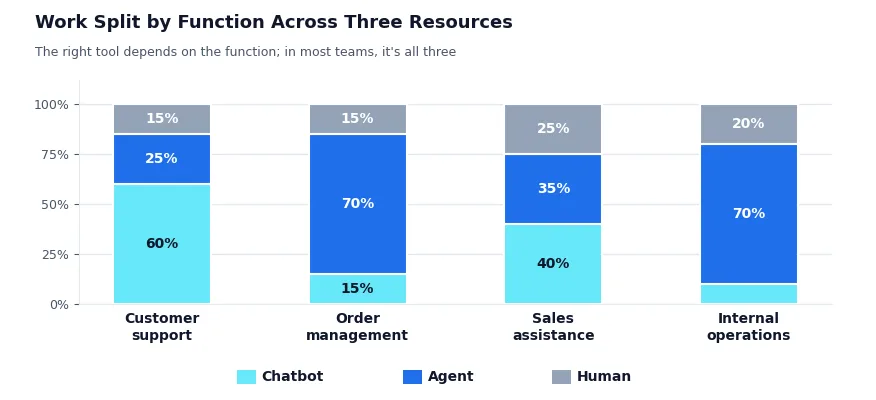
Le choix entre chatbots IA et agents IA est donc capital pour :
- Le support client.
- La gestion des commandes.
- L'assistance aux ventes.
- Les opérations internes.
Par exemple, un chatbot IA répondra à la question : « Où est ma commande ? ». Un agent IA, quant à lui, consultera les registres d'expédition pour trouver le statut exact et générera la réponse. C'est beaucoup plus efficace.
Vous pouvez également observer l'automatisation des flux opérationnels grâce au Kai AI Operational Agent, développé par ExactFlow.
Quand utiliser l'un ou l'autre
Utilisez les chatbots IA lorsque :
- Vous voulez des réponses simples et rapides.
- Vous avez besoin d'un service disponible 24h/24 et 7j/7.
- Les questions se répètent continuellement.
- Vous souhaitez une première ligne d'assistance légère.
Utilisez les agents IA lorsque :
- Vous devez accomplir des tâches sur plusieurs systèmes.
- Vous souhaitez réduire le travail manuel.
- Le processus implique des décisions, de l'aiguillage ou un suivi.
- Votre solution d'IA doit assister activement votre entreprise, et pas seulement discuter.
Pour beaucoup d'entreprises, la stratégie la plus pertinente n'est pas de choisir l'un plutôt que l'autre, mais d'adopter une solution hybride combinant chatbots IA et agents IA.
Tableau 1 · Le bon outil pour la bonne tâche — cartographie des tâches courantes du e-commerce attribuées au chatbot, à l'agent, ou aux deux
| Tâche E-commerce | Meilleur outil | Pourquoi cet outil | À quoi ressemble un bon résultat |
|---|---|---|---|
| Répondre à « Où est ma commande ? » | CHATBOT | Questions successives, récupération rapide d'informations et réactivité sont plus adaptées qu'une action complexe. | Réponse en moins de 3 secondes ; aucun ticket humain n'est créé. |
| Traiter un remboursement sur plusieurs systèmes | AGENT | Nécessite des modifications inter-systèmes (système de commande, paiement, stock) et des décisions conformes aux politiques. | Remboursement validé et client notifié de bout en bout sans intervention humaine. |
| Relance de panier abandonné | LES DEUX | Lorsque le chatbot remarque une hésitation, il engage la conversation. L'agent vérifie ensuite les stocks disponibles réels pour proposer une option concrète. | Vente sauvée, avec la proposition d'un produit de substitution spécifique en stock. |
| Recommander des produits sur une fiche produit (PDP) | AGENT | Doit analyser le comportement des utilisateurs, l'état des stocks et la rentabilité financière avant de prendre une décision. | Les recommandations s'actualisent à chaque visite - le panier moyen augmente de manière mesurable. |
| Questions multilingues sur les tailles | CHATBOT | Il s'agit d'un volume important de demandes purement conversationnelles. Une réponse ultra-rapide est essentielle. | Le client reçoit une réponse instantanée dans sa langue maternelle à la seconde même, sans aucun délai. |
| Réapprovisionnement & coordination fournisseurs | AGENT | Surveille constamment l'état des stocks. Décide quand il est temps de recommander du produit, puis transmet le bon de commande. | Zéro rupture de stock sur les références gérées, pas besoin de traiter des fichiers Excel le vendredi soir. |
| Escalade de réclamation ou client VIP | LES DEUX | Le chatbot accueille & qualifie la demande ; l'agent y associe le contexte complet des systèmes ; l'humain résout le problème. | Le conseiller reçoit un ticket exhaustif et résout le problème en un seul clic. |
| Gestion des FAQ à grande échelle | CHATBOT | Mêmes questions, mêmes réponses, toute la journée, tous les jours. | Le nombre de tickets diminue, et l'équipe peut se concentrer sur les cas les plus complexes. |
Si vous souhaitez analyser les tarifs et les stratégies de déploiement, vous pouvez consulter la page des tarifs de ExactFlow.
Une analogie simple pour comprendre
Un chatbot est comme la personne à l'accueil. Elle salue les visiteurs, leur donne des informations et leur indique où aller.
Un agent est comme la personne qui concrétise les projets. Elle ne se contente pas de répondre aux questions, elle agit concrètement en travaillant avec d'autres logiciels et systèmes informatiques.
C'est là toute la différence entre les chatbots IA et les agents IA : l'un est fait pour interagir avec les gens, l'autre pour exécuter des actions. Les chatbots IA communiquent ; les agents IA agissent.
Comment les entreprises doivent-elles choisir ?
Si vous cherchez à traiter des questions récurrentes, vous devriez vous tourner vers un chatbot. Si votre principal problème réside dans la répétition manuelle des mêmes tâches, vous devriez plutôt envisager un agent.
Les marques de commerce électronique auront probablement intérêt à utiliser les deux de concert. Les équipes de support ont besoin de chatbots pour gérer un grand volume d'utilisateurs simultanément, tandis que les équipes opérationnelles ont besoin d'agents pour automatiser les processus. Même les équipes commerciales peuvent en avoir besoin si elles effectuent actuellement beaucoup de tâches administratives à la main.
Conclusion
La différence fondamentale entre les chatbots IA et les agents IA réside dans le fait que les chatbots échangent avec les humains, alors que les agents IA travaillent de manière autonome en arrière-plan. Ils sont tous deux indispensables, mais répondent à des besoins différents à divers moments de l'expérience client.
Les chatbots IA sont une excellente option pour fournir des réponses rapides. Si vous souhaitez automatiser les processus pour soulager vos équipes et connecter intelligemment vos outils numériques, les agents IA seront d'une aide précieuse.
ExactFlow aide les entreprises de vente en ligne à connecter leurs services de chat et leurs outils d'automatisation intelligents pour permettre aux équipes de travailler plus vite et de traiter plus de volumes efficacement. Pour plus de détails, visitez notre page À propos de nous.
À mesure que l'IA transforme le support client, les ventes et la gestion opérationnelle, la clé du succès ne consiste pas à choisir un seul outil, mais à utiliser le meilleur pour chaque mission, en créant un écosystème où chatbots IA et agents IA collaborent de manière fluide.
Frequently Asked Questions
Que sont les chatbots IA ?
Que sont les chatbots IA ?
Les chatbots IA sont des assistants virtuels conçus pour interagir avec les utilisateurs, répondre à leurs questions et les guider par le biais de conversations textuelles.
Que sont les agents IA ?
Que sont les agents IA ?
Les agents IA sont des systèmes capables de mener des actions concrètes, de prendre des décisions selon des règles établies et de finaliser des tâches impliquant plusieurs logiciels ; ils vont bien au-delà de l'envoi de messages.
Comment fonctionnent les chatbots IA ?
Comment fonctionnent les chatbots IA ?
Les chatbots IA fonctionnent en analysant la demande d'un utilisateur, en recherchant la réponse ou l'action correspondante, puis en fournissant un retour ou en orientant l'utilisateur vers un conseiller humain si nécessaire.
Quel est le meilleur choix : chatbot IA ou agent IA ?
Quel est le meilleur choix : chatbot IA ou agent IA ?
Tout dépend de vos objectifs commerciaux. Un chatbot IA est idéal pour engager la conversation et apporter une aide rapide. Un agent IA est plus adapté pour automatiser des workflows et accomplir des tâches de bout en bout. Dans la plupart des situations, combiner les deux offre les meilleurs résultats.