

12 min read
The ROI of E-commerce Automation: Is It Worth the Investment?
Von ExactFlow Team
8. Juli 2026
When your store starts to grow, the question now isn't whether automation is useful but how you can do it. It depends on the benefits it brings - time, money, and effort - outweigh the expense. This is where the ROI conversation comes into play for any e-commerce company.
Revenue Gains That Start With Automation
For eCommerce teams, ExactFlow automates repetitive tasks and streamlines workflows into seamless, connected processes that save time and empower smarter decisions.
Why automation matters now
Online stores are taking orders, receiving more customer emails, receiving more inventory movement, and completing follow-up than they ever have before. Manual work can work well when you're small, but when you start scaling, there's a cost to doing it. Every extra minute spent on repetitive tasks is time that could have gone into sales, service, or strategy.
Hence, e-commerce automation is no longer a fad but a true business decision. It's not just a matter of simplifying work. It's more about margins improving, error costs dropping, and team speed increasing without having the same overhead.
What ROI means in e-commerce
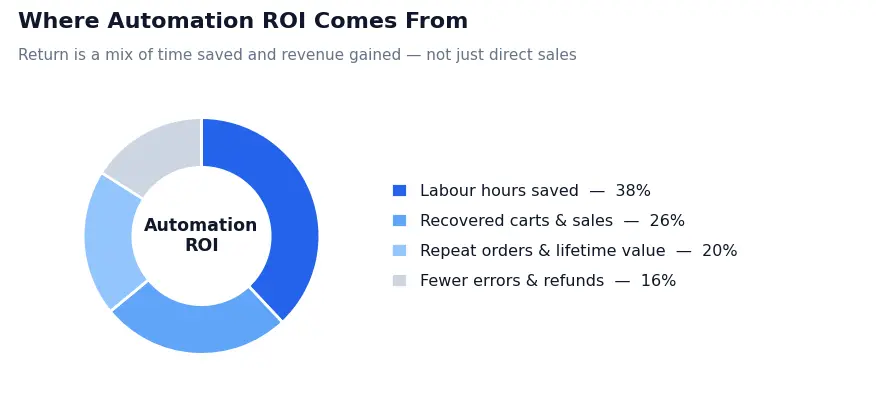
ROI is simply the return you get from the money you spend. In eCommerce, those returns aren't just in terms of direct sales. It also results in reduced labour expenses, fewer errors, shorter order turnaround times, increased satisfaction, and repeat orders.
The investment in tools will be worthless to a business if the tools aren't used well. Conversely, the correct system can be used to lower waste in important areas of the customer journey that can pay for itself. This is why hard savings, as well as growth effects, should be considered when assessing automation.
Where the money is saved
Automation creates savings in many parts of an e-commerce operation. There are some savings that will be seen immediately, and others that will accumulate over time. The single largest contribution can typically be made through elimination of duplicative work that consumes staff time daily.
Common areas where automation pays off
- Order processing.
- Inventory updates.
- Customer notifications.
- Support routing.
- Abandoned cart follow-up.
- Refund and return workflows.
All of these initiatives are individual tasks that need some time each, but when taken as a whole, they can be a big workload. With those tasks automated, at the same time that the business serves more customers, it generally does not need to add headcount.
If you're interested in another perspective on operational scaling and digital systems, you can visit Salesforce.
Why revenue also increases
The best automation systems save much more than time. They also help shops to generate more income. Quick response to abandoned carts can relieve the loss of sales. A more reliable order tracking system can help eliminate customer frustration. Automated post-purchase flows can lead to repeat sales.
This is where e-commerce automation is particularly beneficial. It helps to maintain customer engagement at optimal times, and this aids revenue growth. It enables a store to be consistent, especially when volume starts to grow, a task that is difficult to achieve manually.
Revenue impacts that matter
- Higher conversion rates from timely follow-up.
- Increased repeat orders due to post-purchase engagement.
- Improved upsell and cross-sell opportunities.
- Lower churn using enhanced service speed.
Improving a little in each of these areas can bring a lot of return in the long run.
How to measure return
A smart ROI review should not start with the tool price alone. It should begin with the problem in the business. Looking to decrease workloads, accelerate fulfilment, enhance retention, or minimize manual mistakes? The solution alters the method of measuring value.
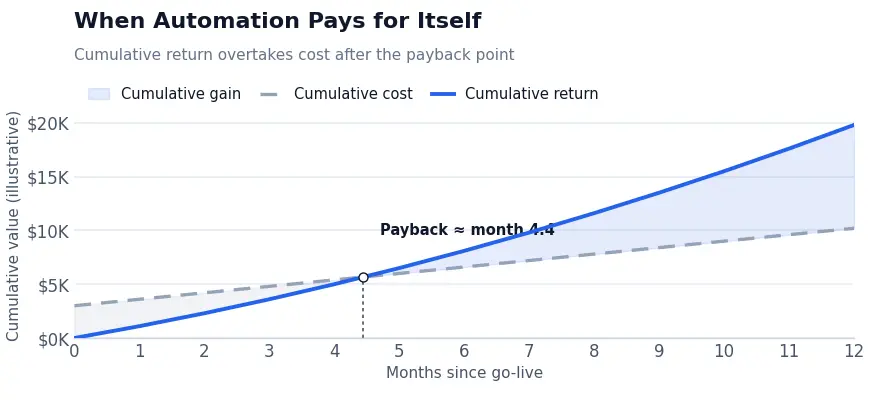
A good indicator for evaluating return is to compare the monthly savings and monthly revenue lift with the cost of the system. That includes setup, training, subscriptions and the time that you spend on implementation. When the total savings and gain exceed the total investment cost within a reasonable time, it is considered to be a profitable investment.
Simple ROI formula
ROI = (gain from investment - cost of investment) / cost of investment
The formula is rather simple, but determining the size of a gain is the hard part. For e-commerce, it can be recovered labour hours, carts recovered, error driven fewer refunds, and increased customer lifetime value.
Key areas that affect ROI
| Area | Manual Process | Automated Process | Business Effect |
|---|---|---|---|
| Order updates | Slow and repetitive | Instant and consistent | Faster fulfillment |
| Customer follow-up | Easy to miss | Triggered automatically | Better retention |
| Inventory sync | Prone to error | Updated in real time | Fewer stock issues |
| Support routing | Manual sorting | Smart assignment | Faster replies |
| Reporting | Time-consuming | Automatic dashboards | Better decisions |
Clearly, this table illustrates how revenue and efficiency can be enhanced through automation. The return need not be restricted to just one department. It follows the entire customer journey.
Why some stores delay the investment
Automation is a concept many businesses are familiar with but still battle to implement. Typically it's because of a fear of complexity. Owners can be concerned about setup time, learning curve, or expensive tools that aren't utilized. Those concerns are valid but are typically short-term thinking.
A good system should simplify work, not create more of it. The return rapidly decreases if the automation makes a lot of maintenance demands or if it needs frequent manual corrections. This is why the integration of a tool and workflow is as important as a tool's feature set.
What makes automation worth it
The highest return on investment is achieved when automation eliminates bottlenecks around high-value, high-volume activities. Essentially, it's selecting workflows that occur frequently, consume time, and are easily standardized. These tend to have the quickest payback period.
High-value use cases
- Sending order confirmations and delivery updates.
- Remind people about abandoned carts.
- Routing tickets to the right support team.
- Maintaining inventory on all channels.
- Sending reorder reminders to repeat customers.
With these workflows in place individually, workers can concentrate on those aspects of the work that require human judgment. That change will typically lead to better productivity without sacrificing the service quality.
The role of customer experience
Automation is not only an internal efficiency tool. It also influences how customers think about the brand. A customer who receives a rapid shipping notification, a timely response to their support inquiry, and a timely follow-up is more likely to return.
That's why e-commerce automation must be considered not just an operational tool, but also a customer experience strategy. The best automation feels invisible to the buyer but highly valuable behind the scenes. It decreases friction, which can make for more trust and more sales.
For anyone who wishes to learn more about how this ties in with an exact workflow design, ExactFlow will be useful as a first point.
Where ExactFlow fits
ExactFlow is designed for e-commerce teams looking for automation with structure and is suitable across sales, support, operations, finance, HR , and more. That's important because real ROI comes from connecting more than one workflow. If systems are integrated, the business eliminates duplication and speeds up the response time.
The right platform should make work easier for the team and clearer for leadership. It shouldn't take people through complex procedures to get them ready for time-saving later. One of the reasons why ExactFlow is relevant when it comes to businesses that need measurable benefits in their operation is that it has captured this.
For teams comparing implementation options, the ExactFlow pricing can help frame the cost side of the decision.
A simple way to think about payback
There are three questions that make it easy to determine investment. What is the current monthly labour hours for the process? Secondly, what value is this time to the person in labor or lost opportunity? Third, how much improvement can automation realistically deliver?
If automation saves 20 hours a month and the staff cost is meaningful, the payback may be fast. If it also boosts conversion or repeat sales, it makes the return even more solid! The optimal systems in eCommerce can achieve cost savings and revenue lift simultaneously.
When it may not be worth it
Automation is not always the solution to all problems. Automating a workflow might not be able to provide the return expected if it is very human-dependent, complex, or rare. Similarly, if there is not enough order volume in the business, the setup/service fee and subscription fee are probably not justified.
That is why the decision should be based on actual business activity, not just trend pressure. A store should be automated gradually to tasks that are repeated more often than they are warranted or consume resources they don't need.
HubSpot provides helpful insights into how organized workflows facilitate growth if you're looking to see a broader picture of business process efficiency.
Conclusion
The ROI of automation depends on what you automate, how often the task repeats, and how much business value it creates. For many online stores, the gains come from a mix of time savings, fewer errors, better customer experience, and stronger sales performance.
When the workflow is chosen well, the investment usually makes sense because it keeps paying back month after month. ExactFlow helps e-commerce teams put that into practice with connected systems that reduce manual work and support growth.
The real question is not whether automation is expensive. It is whether doing everything manually is costing more.
FAQ
1. What is E-commerce Automation?
It is the use of tools and workflows to handle repetitive e-commerce tasks like order updates, follow-ups, inventory syncing, and support routing.
2. How does automation improve ROI?
It improves ROI by reducing labor time, lowering errors, speeding up processes, and helping stores recover more sales.
3. Is e-commerce automation only for large stores?
No. Small stores can also benefit from handling repetitive tasks that require too much manual effort.
4. What should I automate first?
Start with high-volume tasks such as order notifications, abandoned cart reminders, and inventory updates.
5. Can automation improve customer experience?
Yes. It helps customers get faster responses, better updates, and smoother post-purchase communication.
6. How do I know if automation is worth the cost?
Compare the monthly time saved and revenue gained against the total cost of the system, including setup and subscription fees.