12 min read
How E-commerce CRM Can Increase Online Store Revenue
Von ExactFlow Team
6. Juli 2026
Revenue typically doesn't grow because of one big move if your store is growing. It grows when the small actions of the customer are done better, followed up faster, and converted to repeat sales experiences. This is why a good CRM may silently turn out to be among the most profitable systems in business.
Why Smarter Customer Data Drives More Sales
There are many store owners who believe that increased revenue only means increased ads or increased traffic. That is only part of the story. It may well be that better growth comes from knowing your customers better, following up at the right time and making every interaction more relevant. This is where eCommerce CRM picks up the game and is not simply a contact records base but a revenue instrument.
A CRM system will not view every customer as a single sale but recognize the behaviours, timing, and buying patterns. If your store is able to remember customers well, then you can sell to them more smartly.
What an Ecommerce CRM Really Does
An eCommerce CRM is essentially a way for your store to gather and manage customers' information to make decisions based on it. It combines order history, browsing history, support tickets and contact information in a single place. This provides your team with insight into your customer, their purchase and what products they might be interested in next.
This is significant, as income is not just about acquiring new clients. It's also about retaining customers and providing them with an even better reason to come back. Better retention is often the largest source of revenue gains, rather than acquisition, in many retail shops.
What the system connects
- Customer profiles.
- Purchase history.
- Support activity.
- Marketing engagement.
- Follow-up timing.
With these signals linked, the business will be able to make better decisions. So e-commerce CRM has become a critical part of e-commerce growth, instead of a luxury.
To get the big picture of how ExactFlow is tackling customer workflows, check out ExactFlow.
Why Revenue Increases When Customer Management Improves
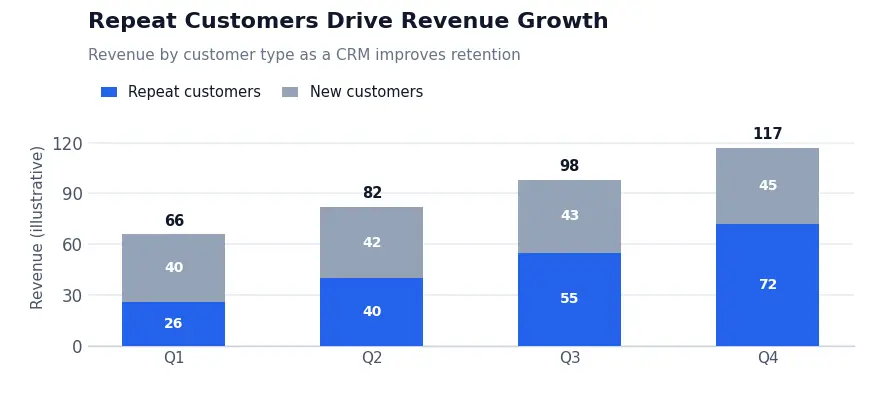
The smoother your customer journey, the more revenue you'll generate. Customers are more likely to purchase again if they receive better support, more relevant messages and quick follow-up. A CRM helps make that happen.
Main revenue effects
- Higher repeat purchases.
- Better upsell timing.
- Faster lead follow-up.
- Fewer lost opportunities.
- Stronger customer loyalty.
When the store has done CRM quite effectively, the results are likely to be impressive in terms of conversion rates, since they are not blindly trying on their own. It's working with actual customer data. This is the real benefit of CRM for eCommerce.
If you're looking to compare pricing and scaling solutions, ExactFlow pricing allows you to get direct insight into how an automation-first environment can scale along with your business.
Why ExactFlow CRM Matters First
ExactFlow is designed to support e-commerce businesses looking for improved operations, sales efficiency and integrated customer communication. It aims to narrow the gap between data and action using its CRM methods. That allows teams to react quicker and deal with relationships more intelligently.
This is important because businesses don't grow simply by adding more information about their customers to their systems. It develops by taking advantage of that information and then using it to make better decisions each day. That is where the ExactFlow CRM, Snoopy Doopy, fits in. It streamlines collaboration to convert customer activity into valuable activity without getting too complicated.
The team can then find a more efficient way to discover data and apply it to boost sales.
How CRM Helps Increase Revenue
There are several ways that a CRM impacts revenue, and each one is important.
1. Better follow-up
Sales failures are usually not due to poor products. They fail because of slow or weak follow-up. A CRM helps your staff to remain consistent.
2. Smarter segmentation
The messaging should not be uniform for all customers. A CRM will help you categorised your buyers based on their behaviour, value, and their journey stage.
3. Higher repeat sales
When you find out what a person purchased last time, it is possible to suggest something better next time. That facilitates upselling and repeat selling.
4. Faster support
Support teams can resolve issues more quickly by having a complete history of the customer. Happy customers will come back.
5. Better forecasting
Good data provides leaders with clues on what is effective and where income is being generated. This helps to make better business decisions.
That's why people are so focused on "CRM e-commerce" these days. It is not just about organisation. It revolves around leveraging customer data to boost sales.
HubSpot offers helpful advice on customer management and retention for a wider understanding of how to support business growth using customer relationship systems.
How a Revenue-Focused CRM Works in Practice
Suppose a person purchases a cosmetic item from your shop. A very simple system is used to record the order. A good CRM does much more. It can tell you when the customer purchased, the type of preference, whether they opened your emails or whether they called customer support.
That allows your team to:
- Send a useful follow-up.
- Offer to refill at the right time.
- Offer a related product.
- If the question does come up, support the customer better.
That's the difference in revenues. It's not about just data storage. You are turning it into action.
A simple comparison
| Area | Without CRM | With e-commerce CRM |
|---|---|---|
| Follow-up | Delayed or forgotten | Timely and structured |
| Customer history | Scattered | Centralised |
| Upsell timing | Guesswork | Based on behaviour |
| Support context | Limited | Complete |
| Repeat purchase potential | Low | Higher |
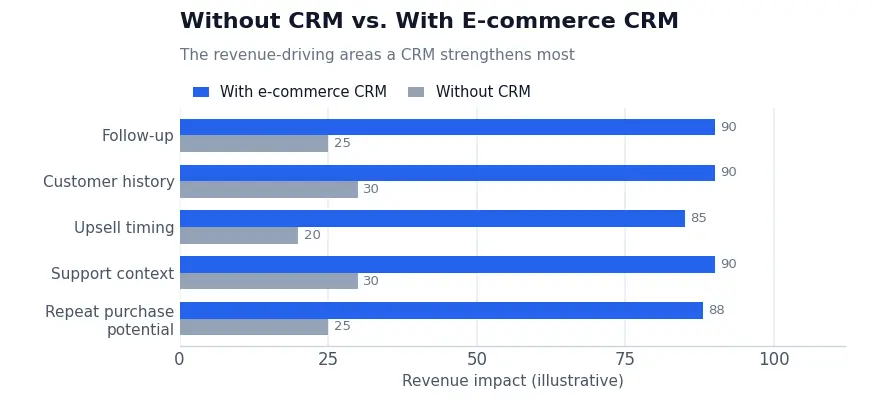
Take a look at this table about the direct impact of e-commerce CRM on revenue. It provides the team with more information and improved timing.
Salesforce is another great example to take a different look at how data and automation help to optimize retail performance.
Why Personalisation Matters So Much
People will respond more to having a message that is relevant. This applies to ads, emails, support and promotions. A CRM makes those moments personalised at scale.
What personalisation can improve
- Email open rates.
- Click-through rates.
- Offer response rates.
- Repeat purchase rates.
- Customer satisfaction.
In return, customers will be more likely to return when they feel understood. This is one of the best revenue advantages of e-commerce CRM.
To get a glimpse into the future of smarter support and more intelligent connections, consider how customer-facing workflows can become more effective with the support of the Axel AI Support Agent.
How CRM Supports Sales and Support Together
One of the biggest problems in e-commerce is that sales and support often work separately. A CRM brings those worlds together. Sales can see customer history. Support can see buying patterns. Marketing can see what customers respond to.
That shared view helps the whole business act more clearly. It also prevents the customer from repeating the same story to different teams.
Why this matters for revenue
- Fewer missed sales.
- Better customer trust.
- Faster resolution.
- More accurate upsell opportunities.
That is why CRM for e-commerce should not be treated as a back-office tool. It belongs in the centre of the revenue process.
For businesses that want to see a connected operational workflow in action, the Kai AI Operational Agent offers another helpful example.
Conclusion
Online store revenue does not grow by chance. It grows when customer relationships are managed well, follow-up is timely, and teams have the right information at the right moment. That is why e-commerce CRM has become such an important part of e-commerce strategy.
A good CRM helps you keep buyers engaged, increase repeat sales, improve support, and make every customer interaction more valuable. It also gives your team a clearer path from customer data to revenue action.
ExactFlow helps e-commerce businesses turn customer data into smarter workflows that support sales, service, and retention.
The strongest stores are not just collecting more contacts. They are using customer insight to make better decisions and build more revenue over time. That is the real power of CRM in e-commerce.
FAQ
1. What is e-commerce CRM?
Ecommerce CRM is a system that helps online stores manage customer data, buying history, and communication in one place.
2. How does e-commerce CRM increase revenue?
It increases revenue by improving follow-up, personalisation, repeat sales, and support quality.
3. What is the difference between CRM for e-commerce and a general CRM?
CRM for e-commerce is designed around online shopping behaviour, order history, and retention, while general CRMs are broader.
4. Can small stores benefit from e-commerce CRM?
Yes. Even small stores can use CRM to improve customer communication and increase repeat purchases.
5. Why does CRM e-commerce matter for support teams?
It gives support teams customer context, which helps them solve problems faster and improve satisfaction.
6. Is CRM in e-commerce only for sales teams?
No. It supports sales, support, marketing, and operations by helping everyone work from the same customer data.